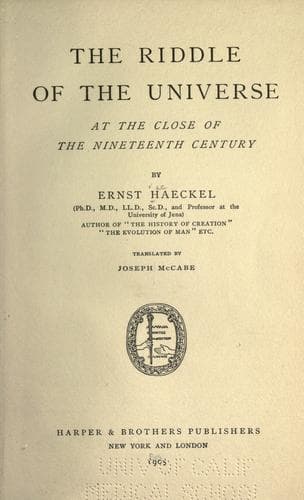
The Riddle of the Universe at the close of the nineteenth centuryHaeckel, Ernst
Religion
The Riddle of the Universe at the close of the nineteenth century
Haeckel, Ernst
Evolution; Monism; Religion and science; Soul
One of the first things to be proved by the law of substance is the
basic fact that any natural force can be directly or indirectly
converted into any other. Mechanical and chemical energy, sound and
heat, light and electricity, are mutually convertible; they seem to be
but different modes of one and the same fundamental force or _energy_.
Thence follows the important thesis of the unity of all natural
forces, or, as it may also be expressed, the "monism of energy."
This fundamental principle is now generally recognized in the entire
province of physics and chemistry, as far as it applies to inorganic
substances.
It seems to be otherwise with the organic world and its wealth of
color and form. It is, of course, obvious that a great part of the
phenomena of life may be immediately traced to mechanical and chemical
energy, and to the effects of electricity and light. For other vital
processes, however, especially for psychic activity and consciousness,
such an interpretation is vigorously contested. Yet the modern science
of evolution has achieved the task of constructing a bridge between
these two apparently irreconcilable provinces. We are now certain that
all the phenomena of organic life are subject to the universal law of
substance no less than the phenomena of the inorganic universe.
The unity of nature which necessarily follows, and the demolition of
the earlier dualism, are certainly among the most valuable results of
modern evolution. Thirty-three years ago I made an exhaustive effort
to establish this "monism of the cosmos" and the essential unity of
organic and inorganic nature by a thorough, critical demonstration,
and a comparison of the accordance of these two great divisions of
nature with regard to matter, form, and force.[29] A short epitome of
the result is given in the fifteenth chapter of my _Natural History
of Creation_. The views I put forward are accepted by the majority
of modern scientists, but an attempt has been made in many quarters
lately to dispute them and to maintain the old antithesis of the two
divisions of nature. The ablest of these is to be found in the recent
_Welt als That_ of the botanist Reinke. It defends _pure cosmological_
dualism with admirable lucidity and consistency, and only goes to prove
how utterly untenable the teleological system is that is connected
therewith. According to the author, physical and chemical forces alone
are at work in the entire field of inorganic nature, while in the
organic world we find "intelligent forces," regulative or dominant
forces. The law of substance is supposed to apply to the one, but not
to the other. On the whole, it is a question of the old antithesis of
a mechanical and a teleological system. But before we go more fully
into it, let us glance briefly at two other theories, which seem to
me to be of great importance in the decision of that controversy--the
carbon-theory and the theory of spontaneous generation.
Public-domain text, read in full here on John Shaqi.
Reviews
Reviews
No reviews yet
Be the first to share your thoughts on this work.
Elsewhere in the archive
Join the Discussion
Join the discussion
Sign in to leave a comment or review.
Sign InorCreate an account