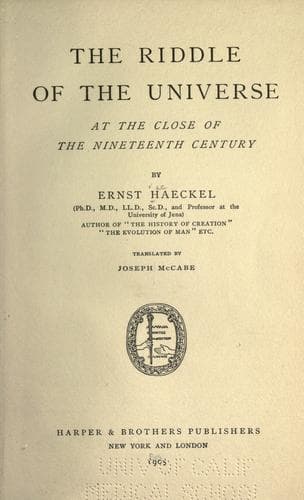
The Riddle of the Universe at the close of the nineteenth centuryHaeckel, Ernst
Religion
The Riddle of the Universe at the close of the nineteenth century
Haeckel, Ernst
Evolution; Monism; Religion and science; Soul
Physiological chemistry has, after countless analyses, established the
following five facts during the last forty years:
I. No other elements are found in organic bodies than those of the
inorganic world.
II. The combinations of elements which are peculiar to organisms,
and which are responsible for their vital phenomena, are compound
protoplasmic substances, of the group of albuminates.
III. Organic life itself is a chemico-physical process, based on the
metabolism (or interchange of material) of these albuminates.
IV. The only element which is capable of building up these compound
albuminates, in combination with other elements (oxygen, hydrogen,
nitrogen, and sulphur), is carbon.
V. These protoplasmic compounds of carbon are distinguished from
most other chemical combinations by their very intricate molecular
structure, their instability, and their jelly-like consistency.
On the basis of these five fundamental facts the following
"carbon-theory" was erected thirty-three years ago: "The peculiar
chemico-physical properties of carbon--especially the fluidity and
the facility of decomposition of the most elaborate albuminoid
compounds of carbon--are the sole and the mechanical causes of
the specific phenomena of movement, which distinguish organic from
inorganic substances, and which are called life, in the usual sense
of the word" (see _The Natural History of Creation_). Although this
"carbon-theory" is warmly disputed in some quarters, no better monistic
theory has yet appeared to replace it. We have now a much better and
more thorough knowledge of the physiological relations of cell-life,
and of the chemistry and physics of the living protoplasm, than we had
thirty-three years ago, and so it is possible to make a more confident
and effective defence of the carbon-theory.
Public-domain text, read in full here on John Shaqi.
Reviews
Reviews
No reviews yet
Be the first to share your thoughts on this work.
Elsewhere in the archive
Join the Discussion
Join the discussion
Sign in to leave a comment or review.
Sign InorCreate an account