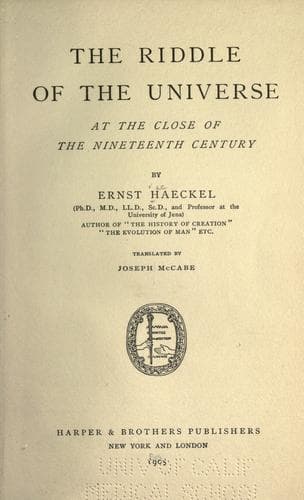
The Riddle of the Universe at the close of the nineteenth centuryHaeckel, Ernst
Religion
The Riddle of the Universe at the close of the nineteenth century
Haeckel, Ernst
Evolution; Monism; Religion and science; Soul
The old idea of spontaneous generation is now taken in many different
senses. It is owing to this indistinctness of the idea, and its
application to so many different hypotheses, that the problem is one
of the most contentious and confused of the science of the day. I
restrict the idea of spontaneous generation--also called abiogenesis
or archigony--to the first development of living protoplasm out of
inorganic carbonates, and distinguish two phases in this "beginning
of biogenesis": (1) _autogony_, or the rise of the simplest
protoplasmic substances in a formative fluid, and (2) _plasmogony_,
the differentiation of individual primitive organisms out of these
protoplasmic compounds, in the form of _monera_. I have treated this
important, though difficult, problem so exhaustively in the fifteenth
chapter of my _Natural History of Creation_ that I may content myself
here with referring to it. There is also a very searching and severely
scientific inquiry into it in my _General Morphology_ (1866). Naegeli
has also treated the hypothesis in quite the same sense in his
mechanico-physiological theory of descent (1884), and has represented
it to be an indispensable thesis in any natural theory of evolution.
I entirely agree with his assertion that "to reject abiogenesis is to
admit a miracle."
The hypothesis of spontaneous generation and the allied carbon-theory
are of great importance in deciding the long-standing conflict between
the _teleological_ (dualistic) and the _mechanical_ (monistic)
interpretation of phenomena. Since Darwin gave us the key to the
monistic explanation of organization in his theory of selection forty
years ago, it has become possible for us to trace the splendid variety
of orderly tendencies of the organic world to mechanical, natural
causes, just as we could formerly in the inorganic world alone. Hence
the supernatural and telic forces, to which the scientist had had
recourse, have been rendered superfluous. Modern metaphysics, however,
continues to regard the latter as indispensable and the former as
inadequate.
Public-domain text, read in full here on John Shaqi.
Reviews
Reviews
No reviews yet
Be the first to share your thoughts on this work.
Elsewhere in the archive
Join the Discussion
Join the discussion
Sign in to leave a comment or review.
Sign InorCreate an account