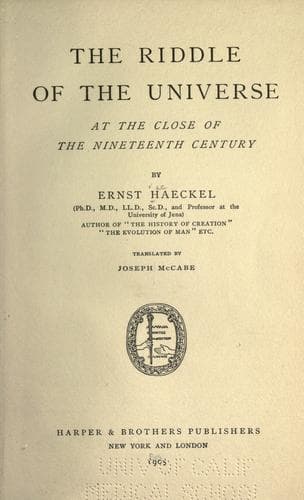
The Riddle of the Universe at the close of the nineteenth centuryHaeckel, Ernst
Religion
The Riddle of the Universe at the close of the nineteenth century
Haeckel, Ernst
Evolution; Monism; Religion and science; Soul
No philosopher has done more than Immanuel Kant in defining the
profound distinction between efficient and final causes, with relation
to the interpretation of the whole cosmos. In his well-known earlier
work on _The General Natural History and Theory of the Heavens_ he
made a bold attempt "to treat the constitution and the mechanical
origin of the entire fabric of the universe according to Newtonian
laws." This "cosmological nebular theory" was based entirely on the
mechanical phenomena of gravitation. It was expanded and mathematically
established later on by Laplace. When the famous French astronomer
was asked by Napoleon I. where God, the creator and sustainer of all
things, came in in his system, he clearly and honestly replied: "Sire,
I have managed without that hypothesis." That indicated the atheistic
character which this mechanical cosmogony shares with all the other
inorganic sciences. This is the more noteworthy because the theory of
Kant and Laplace is now almost universally accepted; every attempt to
supersede it has failed. When atheism is denounced as a grave reproach,
as it so often is, it is well to remember that the reproach extends to
the whole of modern science, in so far as it gives a purely mechanical
interpretation of the inorganic world.
Mechanicism (in the Kantian sense) alone can give us a true explanation
of natural phenomena, for it traces them to their real efficient
causes, to blind and unconscious agencies, which are determined in
their action only by the material constitution of the bodies we are
investigating. Kant himself emphatically affirms that "there can be
no science without this mechanicism of nature," and that the capacity
of human reason to give a mechanical interpretation of phenomena is
unlimited. But when he came subsequently to give an elucidation of
the complex phenomena of organic nature in his _critique_ of the
teleological system, he declared that these mechanical causes were
inadequate; that in this we must call _final causes_ to our assistance.
It is true, he said, that even here we must recognize the theoretical
faculty of the mind to give a mechanical interpretation, but its actual
competence to do so is restricted. He grants it this capacity to some
extent; but for the majority of the vital processes (and especially for
man's psychic activity) he thinks we are bound to postulate _final_
causes. The remarkable §79 of the _critique_ of judgment bears the
characteristic heading: "On the Necessity for the Subordination of
the Mechanical Principle to the Teleological in the Explanation of a
Thing as a Natural End." It seemed to Kant so impossible to explain
the orderly processes in the living organism without postulating
supernatural final causes (that is, a purposive creative force) that
he said: "It is quite certain that we cannot even satisfactorily
understand, much less elucidate, the nature of an organism and its
internal faculty on purely mechanical natural principles; it is so
Public-domain text, read in full here on John Shaqi.
Reviews
Reviews
No reviews yet
Be the first to share your thoughts on this work.
Elsewhere in the archive
Join the Discussion
Join the discussion
Sign in to leave a comment or review.
Sign InorCreate an account