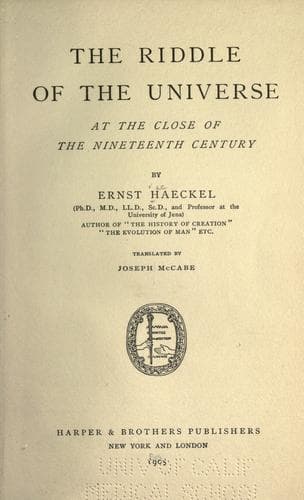
The Riddle of the Universe at the close of the nineteenth centuryHaeckel, Ernst
Religion
The Riddle of the Universe at the close of the nineteenth century
Haeckel, Ernst
Evolution; Monism; Religion and science; Soul
certain, indeed, that we may confidently say, 'It is absurd for a man
to conceive the idea even that some day a Newton will arise who can
explain the origin of a single blade of grass by natural laws which are
uncontrolled by design'--such a hope is entirely forbidden us." Seventy
years afterwards this impossible "Newton of the organic world" appeared
in the person of Charles Darwin, and achieved the great task that Kant
had deemed impracticable.
Since Newton (1682) formulated the law of gravitation, and Kant (1755)
established "the constitution and mechanical origin of the entire
fabric of the world on Newtonian laws," and Laplace (1796) provided
a mathematical foundation for this law of cosmic mechanicism, the
whole of the inorganic sciences have become purely _mechanical_, and
at the same time purely _atheistic_. Astronomy, cosmogony, geology,
meteorology, and inorganic physics and chemistry are now absolutely
ruled by mechanical laws on a mathematical foundation. The idea of
"design" has wholly disappeared from this vast province of science.
At the close of the nineteenth century, now that this monistic view
has fought its way to general recognition, no scientist ever asks
seriously of the "purpose" of any single phenomenon in the whole of
this great field. Is any astronomer likely to inquire seriously to-day
into the purpose of planetary motion, or a mineralogist to seek design
in the structure of a crystal? Does the physicist investigate the
purpose of electric force, or the chemist that of atomic weight? We
may confidently answer in the negative--certainly not, in the sense
that God, or a purposive natural force, had at some time created these
fundamental laws of the mechanism of the universe with a definite
design, and causes them to work daily in accordance with his rational
will. The anthropomorphic notion of a deliberate architect and ruler of
the world has gone forever from this field; the "eternal, iron laws of
nature" have taken his place.
Public-domain text, read in full here on John Shaqi.
Reviews
Reviews
No reviews yet
Be the first to share your thoughts on this work.
Elsewhere in the archive
Join the Discussion
Join the discussion
Sign in to leave a comment or review.
Sign InorCreate an account