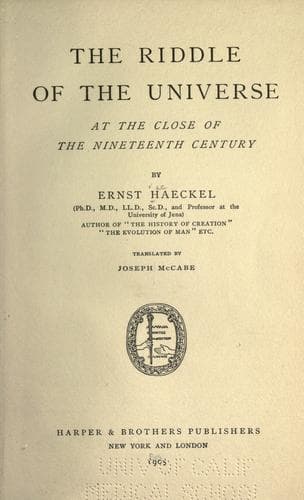
The Riddle of the Universe at the close of the nineteenth centuryHaeckel, Ernst
Religion
The Riddle of the Universe at the close of the nineteenth century
Haeckel, Ernst
Evolution; Monism; Religion and science; Soul
But the idea of design has a very great significance and application
in the _organic_ world. We do undeniably perceive a purpose in the
structure and in the life of an organism. The plant and the animal
seem to be controlled by a definite design in the combination of their
several parts, just as clearly as we see in the machines which man
invents and constructs; as long as life continues the functions of the
several organs are directed to definite ends, just as is the operation
of the various parts of a machine. Hence it was quite natural that the
older naïve study of nature, in explaining the origin and activity
of the living being, should postulate a creator who had "arranged
all things with wisdom and understanding," and had constructed each
plant and animal according to the special purpose of its life. The
conception of this "almighty creator of heaven and earth" was usually
quite anthropomorphic; he created "everything after its kind." As long
as the creator seemed to man to be of human shape, to think with his
brain, see with his eyes, and fashion with his hands, it was possible
to form a definite picture of this "divine engineer" and his artistic
work in the great workshop of creation. This was not so easy when
the idea of God became refined, and man saw in his "invisible God" a
creator without organs--a gaseous being. Still more unintelligible
did these anthropomorphic ideas become when physiology substituted
for the conscious, divine architect an unconscious, creative "vital
force"--a mysterious, purposive, natural force, which differed from the
familiar forces of physics and chemistry, and only took these in part,
during life, into its service. This vitalism prevailed until about the
middle of the nineteenth century. Johannes Müller, the great Berlin
physiologist, was the first to menace it with a destructive dose of
facts. It is true that the distinguished biologist had himself (like
all others in the first half of the century) been educated in a belief
in this vital force, and deemed it indispensable for an elucidation of
the ultimate sources of life; nevertheless, in his classical and still
unrivalled _Manual of Physiology_ (1833) he gave a demonstrative proof
that there is really nothing to be said for this vital force. Müller
himself, in a long series of remarkable observations and experiments,
showed that most of the vital processes in the human organism (and in
the other animals) take place according to physical and chemical laws,
and that many of them are capable of mathematical determination. That
was no less true of the animal functions of the muscles and nerves,
and of both the higher and the lower sense-organs, than of the vegetal
functions of digestion, assimilation, and circulation. Only two
branches of the life of the organism, mental action and reproduction,
retained any element of mystery, and seemed inexplicable without
assuming a vital force. But immediately after Müller's death such
Public-domain text, read in full here on John Shaqi.
Reviews
Reviews
No reviews yet
Be the first to share your thoughts on this work.
Elsewhere in the archive
Join the Discussion
Join the discussion
Sign in to leave a comment or review.
Sign InorCreate an account