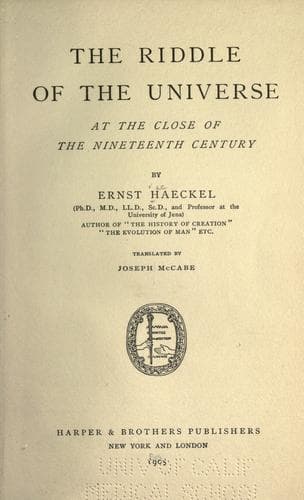
The Riddle of the Universe at the close of the nineteenth centuryHaeckel, Ernst
Religion
The Riddle of the Universe at the close of the nineteenth century
Haeckel, Ernst
Evolution; Monism; Religion and science; Soul
important discoveries and advances were made in these two branches
that the uneasy "phantom of vital force" was driven from its last
refuge. By a very remarkable coincidence Johannes Müller died in the
year 1858, which saw the publication of Darwin's first communication
concerning his famous theory. The theory of selection solved the great
problem that had mastered Müller--the question of the origin of orderly
arrangements from purely mechanical causes.
Darwin, as we have often said, had a twofold immortal merit in the
field of philosophy--firstly, the reform of Lamarck's theory of
descent, and its establishment on the mass of facts accumulated in the
course of the half-century; secondly, the conception of the theory
of selection, which first revealed to us the true causes of the
gradual formation of species. Darwin was the first to point out that
the "struggle for life" is the unconscious regulator which controls
the reciprocal action of heredity and adaptation in the gradual
transformation of species; it is the great "selective divinity" which,
by a purely "natural choice," without preconceived design, creates
new forms, just as selective man creates new types by an "artificial
choice" with a definite design. That gave us the solution of the great
philosophic problem: "How can purposive contrivances be produced by
purely mechanical processes without design?" Kant held the problem to
be insoluble, although Empedocles had pointed out the direction of the
solution two thousand years before. His principle of "teleological
mechanism" has become more and more accepted of late years, and
has furnished a mechanical explanation even of the finest and most
recondite processes of organic life by "the functional self-production
of the purposive structure." Thus have we got rid of the transcendental
"design" of the ideological philosophy of the schools, which was the
greatest obstacle to the growth of a rational and monistic conception
of nature.
Very recently, however, this ancient phantom of a mystic vital force,
which seemed to be effectually banished, has put in a fresh appearance;
a number of distinguished biologists have attempted to reintroduce it
under another name. The clearest presentation of it is to be found in
the _Welt als That_, of the Kiel botanist, J. Reinke. He takes upon
himself the defence of the notion of miracle, of theism, of the Mosaic
story of creation, and of the constancy of species; he calls "vital
forces," in opposition to physical forces, the directive or dominant
forces. Other neovitalists prefer, in the good old anthropomorphic
style, a "supreme" engineer, who has endowed organic substance with a
purposive structure, directed to the realization of a definite plan.
These curious teleological hypotheses, and the objections to Darwinism
which generally accompany them, do not call for serious scientific
refutation to-day.
Public-domain text, read in full here on John Shaqi.
Reviews
Reviews
No reviews yet
Be the first to share your thoughts on this work.
Elsewhere in the archive
Join the Discussion
Join the discussion
Sign in to leave a comment or review.
Sign InorCreate an account