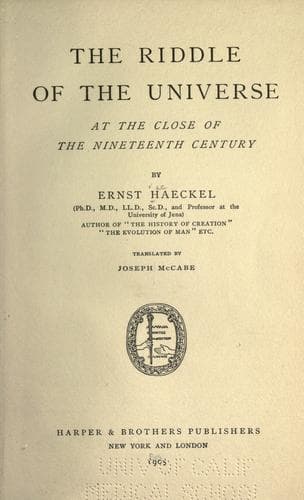
The Riddle of the Universe at the close of the nineteenth centuryHaeckel, Ernst
Religion
The Riddle of the Universe at the close of the nineteenth century
Haeckel, Ernst
Evolution; Monism; Religion and science; Soul
Thirty-three years ago I gave the title of "dysteleology" to the
science of those extremely interesting and significant biological
facts, which, in the most striking fashion, give a direct contradiction
to the teleological idea "of the purposive arrangement of the living
organism."[30] This "science of rudimentary, abortive, arrested,
distorted, atrophied, and cataplastic individuals" is based on an
immense quantity of remarkable phenomena, which were long familiar to
zoologists and botanists, but were not properly interpreted, and their
great philosophic significance appreciated, until Darwin.
All the higher animals and plants, or, in general, all organisms which
are not entirely simple in structure, but are made up of a number of
organs in orderly co-operation, are found, on close examination, to
possess a number of useless or inoperative members, sometimes, indeed,
hurtful and dangerous. In the flowers of most plants we find, besides
the actual sex-leaves that effect reproduction, a number of other
leaf-organs which have no use or meaning (arrested or "miscarried"
pistils, fruit, corona, and calix-leaves, etc.). In the two large and
variegated classes of flying animals, birds and insects, there are,
besides the forms which make constant use of their wings, a number of
species which have undeveloped wings and cannot fly. In nearly every
class of the higher animals which have eyes there are certain types
that live in the dark; they have eyes, as a rule, but undeveloped and
useless for vision. In our own human organism we have similar useless
rudimentary structures in the muscles of the ear, in the eye-lid, in
the nipple and milk-gland of the male, and in other parts of the body;
indeed, the vermiform appendix of our cæcum is not only useless, but
extremely dangerous, and inflammation of it is responsible for a number
of deaths every year.
Neither the old mystic vitalism nor the new, equally irrational,
neovitalism can give any explanation of these and many other
purposeless contrivances in the structure of the plant and the animal;
but they are very simple in the light of the theory of descent. It
shows that these rudimentary organs are atrophied, owing to disuse.
Just as our muscles, nerves, and organs of sense are strengthened by
exercise and frequent use, so, on the other hand, they are liable to
degenerate more or less by disuse or suspended exercise. But, although
the development of the organs is promoted by exercise and adaptation,
they by no means disappear without leaving a trace after neglect; the
force of heredity retains them for many generations, and only permits
their gradual disappearance after the lapse of a considerable time.
The blind "struggle for existence between the organs" determines their
historical disappearance, just as it effected their first origin and
development. There is no internal "purpose" whatever in the drama.
Public-domain text, read in full here on John Shaqi.
Reviews
Reviews
No reviews yet
Be the first to share your thoughts on this work.
Elsewhere in the archive
Join the Discussion
Join the discussion
Sign in to leave a comment or review.
Sign InorCreate an account