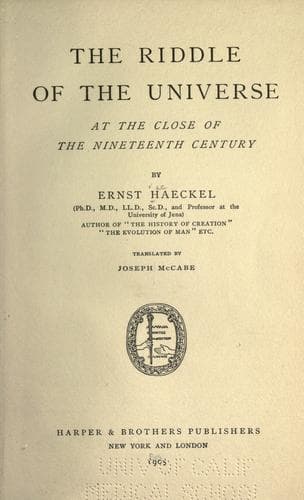
The Riddle of the Universe at the close of the nineteenth centuryHaeckel, Ernst
Religion
The Riddle of the Universe at the close of the nineteenth century
Haeckel, Ernst
Evolution; Monism; Religion and science; Soul
The dogma of the "Trinity," which still comprises three of the chief
articles of faith in the creed of Christian peoples, culminates in the
notion that the one God of Christianity is really made up of _three_
different persons: (1) God the Father, the omnipotent creator of heaven
and earth (this untenable myth was refuted long ago by scientific
cosmogony, astronomy, and geology); (2) Jesus Christ; and (3) the Holy
Ghost, a mystical being, over whose incomprehensible relation to the
Father and the Son millions of Christian theologians have racked their
brains in vain for the last nineteen hundred years. The Gospels, which
are the only clear sources of this _triplotheism_, are very obscure as
to the relation of these three persons to each other, and do not give a
satisfactory answer to the question of their unity. On the other hand,
it must be carefully noted what confusion this obscure and mystic dogma
of the Trinity must necessarily cause in the minds of our children even
in the earlier years of instruction. One morning they learn (in their
religious instruction) that three times one are one, and the very next
hour they are told in their arithmetic class that three times one are
three. I remember well the reflection that this confusion led me to in
my early school-days.
For the rest, the "Trinity" is not an original element in Christianity;
like most of the other Christian dogmas, it has been borrowed from
earlier religions. Out of the sun-worship of the Chaldean magi was
evolved the Trinity of Ilu, the mysterious source of the world; its
three manifestations were Anu, primeval chaos; Bel, the architect of
the world; and Aa, the heavenly light, the all-enlightening wisdom.
In the Brahmanic religion the Trimurti is also conceived as a "divine
unity" made up of three persons--Brahma (the creator), Vishnu (the
sustainer), and Shiva (the destroyer). It would seem that in this
and other ideas of a Trinity the "sacred number, three," as such--as
a "symbolical number"--has counted for something. The three first
Christian virtues--Faith, Hope, and Charity--form a similar _triad_.
According to the _amphitheists_, the world is ruled by two different
gods, a good and an evil principle, God and the Devil. They are engaged
in a perpetual struggle, like rival emperors, or pope and anti-pope.
The condition of the world is the result of this conflict. The
loving God, or good principle, is the source of all that is good and
beautiful, of joy and of peace. The world would be perfect if His work
were not continually thwarted by the evil principle, the Devil; this
being is the cause of all that is bad and hateful, of contradiction and
of pain.
Public-domain text, read in full here on John Shaqi.
Reviews
Reviews
No reviews yet
Be the first to share your thoughts on this work.
Elsewhere in the archive
Join the Discussion
Join the discussion
Sign in to leave a comment or review.
Sign InorCreate an account