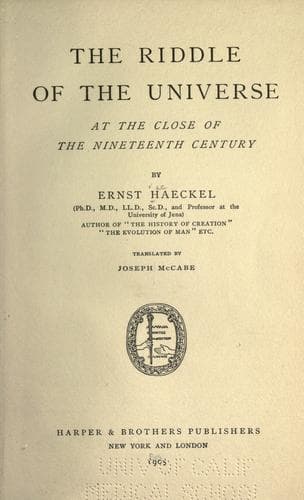
The Riddle of the Universe at the close of the nineteenth centuryHaeckel, Ernst
Religion
The Riddle of the Universe at the close of the nineteenth century
Haeckel, Ernst
Evolution; Monism; Religion and science; Soul
Amphitheism is undoubtedly the most rational of all forms of belief in
God, and the one which is least incompatible with a scientific view
of the world. Hence we find it elaborated in many ancient peoples
thousands of years before Christ. In ancient India Vishnu, the
preserver, struggles with Shiva, the destroyer. In ancient Egypt the
good Osiris is opposed by the wicked Typhon. The early Hebrews had a
similar dualism of Aschera (or Keturah), the fertile mother-earth,
and Elion (Moloch or Sethos), the stern heavenly father. In the Zend
religion of the ancient Persians, founded by Zoroaster two thousand
years before Christ, there is a perpetual struggle between Ormuzd, the
good god of light, and Ahriman, the wicked god of darkness.
In Christian mythology the Devil is scarcely less conspicuous as the
adversary of the good deity, the tempter and seducer, the prince of
hell, and lord of darkness. A personal devil was still an important
element in the belief of most Christians at the beginning of the
nineteenth century. Towards the middle of the century he was gradually
eliminated by being progressively explained away, or he was restricted
to the subordinate _rôle_ he plays as Mephistopheles in Goethe's great
drama. To-day the majority of educated people look upon "belief in a
personal devil" as a mediæval superstition, while "belief in God" (that
is, the personal, good, and loving God) is retained as an indispensable
element of religion. Yet the one belief is just as much (or as little)
justified as the other. In any case, the much-lamented "imperfection of
our earthly life," the "struggle for existence," and all that pertains
to it, are explained much more simply and naturally by this struggle of
a good and an evil god than by any other form of theism.
Public-domain text, read in full here on John Shaqi.
Reviews
Reviews
No reviews yet
Be the first to share your thoughts on this work.
Elsewhere in the archive
Join the Discussion
Join the discussion
Sign in to leave a comment or review.
Sign InorCreate an account