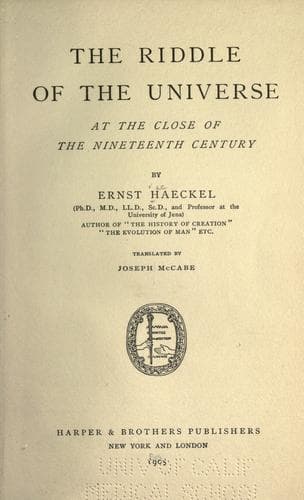
The Riddle of the Universe at the close of the nineteenth centuryHaeckel, Ernst
Religion
The Riddle of the Universe at the close of the nineteenth century
Haeckel, Ernst
Evolution; Monism; Religion and science; Soul
The dogma of the unity of God may in some respects be regarded as the
simplest and most natural type of theism; it is popularly supposed to
be the most widely accepted element of religion, and to predominate
in the ecclesiastical systems of civilized countries. In reality,
that is not the case, because this alleged "monotheism" usually turns
out on closer inquiry to be one of the other forms of theism we have
examined, a number of subordinate deities being generally introduced
besides the supreme one. Most of the religions which took a purely
monotheistic stand-point have become more or less polytheistic in the
course of time. Modern statistics assure us that of the one billion
five hundred million men who people the earth the great majority
are monotheists; of these, _nominally_, about six hundred millions
are Brahma-Buddhists, five hundred millions are called Christians,
two hundred millions are heathens (of various types), one hundred
and eighty millions are Mohammedans, ten millions are Jews, and ten
millions have no religion at all. However, the vast majority of
these nominal monotheists have very confused ideas about the deity,
or believe in a number of gods and goddesses besides the chief
god--angels, devils, etc.
The different forms which monotheism has assumed in the course of its
polyphyletic development may be distributed in two groups--those of
_naturalistic_ and _anthropistic_ monotheism. Naturalistic monotheism
finds the embodiment of the deity in some lofty and dominating natural
phenomenon. The sun, the deity of light and warmth, on whose influence
all organic life insensibly and directly depends, was taken to be
such a phenomenon many thousand years ago. Sun-worship (solarism,
or heliotheism) seems to the modern scientist to be the best of all
forms of theism, and the one which may be most easily reconciled
with modern monism. For modern astrophysics and geogeny have taught
us that the earth is a fragment detached from the sun, and that it
will eventually return to the bosom of its parent. Modern physiology
teaches us that the first source of organic life on the earth is the
formation of protoplasm, and that this synthesis of simple inorganic
substances, water, carbonic acid, and ammonia, only takes place under
the influence of sunlight. On the primary evolution of the plasmodomous
plants followed, secondarily, that of the plasmophagous animals, which
directly or indirectly depend on them for nourishment; and the origin
of the human race itself is only a later stage in the development of
the animal kingdom. Indeed, the whole of our bodily and mental life
depends, in the last resort, like all other organic life, on the
light and heat rays of the sun. Hence in the light of pure reason,
sun-worship, as a form of naturalistic monotheism, seems to have a much
better foundation than the anthropistic worship of Christians and of
other monotheists who conceive their god in human form. As a matter of
Public-domain text, read in full here on John Shaqi.
Reviews
Reviews
No reviews yet
Be the first to share your thoughts on this work.
Elsewhere in the archive
Join the Discussion
Join the discussion
Sign in to leave a comment or review.
Sign InorCreate an account