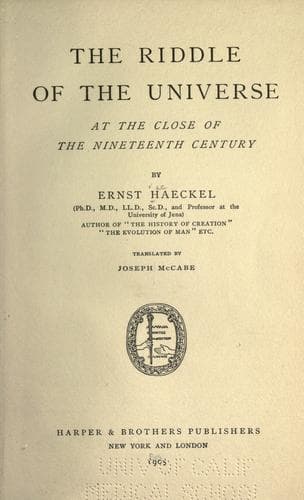
The Riddle of the Universe at the close of the nineteenth centuryHaeckel, Ernst
Religion
The Riddle of the Universe at the close of the nineteenth century
Haeckel, Ernst
Evolution; Monism; Religion and science; Soul
The presentations which fill up the gaps in our knowledge, or take its
place, may be called, in a broad sense, "faith." That is what happens
continually in daily life. When we are not sure about a thing we say, I
believe it. In this sense we are compelled to make use of faith even in
science itself; we conjecture or assume that a certain relation exists
between two phenomena, though we do not know it for certain. If it is
a question of a _cause_, we form a _hypothesis_; though in science
only such hypotheses are admitted as lie within the sphere of human
cognizance, and do not contradict known facts. Such hypotheses are, for
instance--in physics the theory of the vibratory movement of ether, in
chemistry the hypothesis of atoms and their affinity, in biology the
theory of the molecular structure of living protoplasm, and so forth.
The explanation of a great number of connected phenomena by the
assumption of a common cause is called a _theory_. Both in theory and
hypothesis "faith" (in the scientific sense) is indispensable; for
here again it is the imagination that fills up the gaps left by the
intelligence in our knowledge of the connection of things. A theory,
therefore, must always be regarded only as an approximation to the
truth; it must be understood that it may be replaced in time by another
and better-grounded theory. But, in spite of this admitted uncertainty,
theory is indispensable for all true science; it elucidates facts by
postulating a cause for them. The man who renounces theory altogether,
and seeks to construct a pure science with certain facts alone
(as often happens with wrong-headed representatives of our "exact
sciences"), must give up the hope of any knowledge of causes, and,
consequently, of the satisfaction of reason's demand for causality.
Public-domain text, read in full here on John Shaqi.
Reviews
Reviews
No reviews yet
Be the first to share your thoughts on this work.
Elsewhere in the archive
Join the Discussion
Join the discussion
Sign in to leave a comment or review.
Sign InorCreate an account