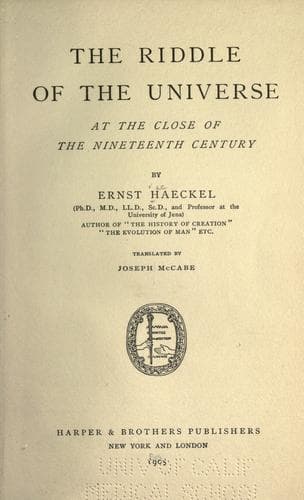
The Riddle of the Universe at the close of the nineteenth centuryHaeckel, Ernst
Religion
The Riddle of the Universe at the close of the nineteenth century
Haeckel, Ernst
Evolution; Monism; Religion and science; Soul
The theory of gravitation in astronomy (Newton), the nebular theory
in cosmogony (Kant and Laplace), the principle of energy in physics
(Meyer and Helmholtz), the atomic theory in chemistry (Dalton), the
vibratory theory in optics (Huyghens), the cellular theory in histology
(Schleiden and Schwann), and the theory of descent in biology (Lamarck
and Darwin), are all important theories of the first rank; they explain
a whole world of natural phenomena by the assumption of a common cause
for all the several facts of their respective provinces, and by showing
that all the phenomena thereof are inter-connected and controlled by
laws which issue from this common cause. Yet the cause itself may
remain obscure in character, or be merely a "provisional hypothesis."
The "force of gravity" in the theory of gravitation and in cosmogony,
"energy" itself in its relation to matter, the "ether" of optics
and electricity, the "atom" of the chemist, the living "protoplasm"
of histology, the "heredity" of the evolutionist--these and similar
conceptions of other great theories may be regarded by a sceptical
philosophy as "mere hypotheses" and the outcome of scientific "faith,"
yet they are indispensable for us, until they are replaced by better
hypotheses.
The dogmas which are used for the explanation of phenomena in the
various religions, and which go by the name of "faith" (in the narrower
sense), are of a very different character from the forms of scientific
faith we have enumerated. The two types, however--the "natural"
faith of science and the "supernatural" faith of religion--are not
infrequently confounded, so that we must point out their fundamental
difference. Religious faith means always belief in a miracle, and as
such is in hopeless contradiction with the natural faith of reason.
In opposition to reason it postulates supernatural agencies, and,
therefore, may be justly called superstition. The essential difference
of this superstition from rational faith lies in the fact that it
assumes supernatural forces and phenomena, which are unknown and
inadmissible to science, and which are the outcome of illusion and
fancy; moreover, superstition contradicts the well-known laws of
nature, and is therefore _irrational_.
Public-domain text, read in full here on John Shaqi.
Reviews
Reviews
No reviews yet
Be the first to share your thoughts on this work.
Elsewhere in the archive
Join the Discussion
Join the discussion
Sign in to leave a comment or review.
Sign InorCreate an account