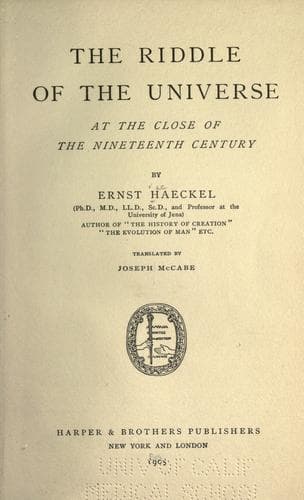
The Riddle of the Universe at the close of the nineteenth centuryHaeckel, Ernst
Religion
The Riddle of the Universe at the close of the nineteenth century
Haeckel, Ernst
Evolution; Monism; Religion and science; Soul
The remarkable personality of Paul, who possessed much more culture
and practical sense than Christ, is extremely interesting, from the
anthropological point of view, from the fact that the racial origin
of the two great religious founders is very much the same. Recent
historical investigation teaches that Paul's father was of Greek
nationality, and his mother of Jewish.[33] The half-breeds of these two
races, which are so very distant in origin (although they are branches
of the same species, the _homo mediterraneus_), are often distinguished
by a happy blending of talents and temperament, as we find in many
recent and actual instances. The plastic Oriental imagination and the
critical Western reason often admirably combine and complete each
other. That is visible in the Pauline teaching, which soon obtained a
greater influence than the earliest Christian notions. Hence it is not
incorrect to consider Paulinism a new phenomenon, of which the father
was the philosophy of the Greeks, and the mother the religion of the
Jews. Neoplatonism is an analogous combination.
As to the real teaching and aims of Christ (and as to many important
aspects of his life) the views of conflicting theologians diverge
more and more, as historical criticism (Strauss, Feuerbach, Baur,
Renan, etc.) puts the accessible facts in their true light, and draws
impartial conclusions from them. Two things, certainly, remain beyond
dispute--the lofty principle of universal charity and the fundamental
maxim of ethics, the "golden rule," that issues therefrom; both,
however, existed in theory and in practice centuries before the time
of Christ (cf. chap. xix.). For the rest, the Christians of the early
centuries were generally pure Communists, sometimes "Social Democrats,"
who, according to the prevailing theory in Germany to-day, ought to
have been exterminated with fire and sword.
II.--PAPAL CHRISTIANITY
Latin Christianity, variously called Papistry, Romanism, Vaticanism,
Ultramontanism, or the Roman Catholic Church, is one of the most
remarkable phenomena in the history of civilized man; in spite of
the storms that have swept over it, it still exerts a most powerful
influence. Of the four hundred and ten million Christians who are
scattered over the earth the majority--that is, two hundred and
twenty-five millions--are Roman Catholics; there are seventy-five
million Greek Catholics and one hundred and ten million Protestants.
During a period of one thousand two hundred years, from the fourth to
the sixteenth century, the papacy has almost absolutely controlled and
tainted the spiritual life of Europe; on the other hand, it has won but
little territory from the ancient religions of Asia and Africa. In Asia
Buddhism still counts five hundred and three million followers, the
Brahmanic religion one hundred and thirty-eight millions, and Islam one
hundred and twenty millions.
Public-domain text, read in full here on John Shaqi.
Reviews
Reviews
No reviews yet
Be the first to share your thoughts on this work.
Elsewhere in the archive
Join the Discussion
Join the discussion
Sign in to leave a comment or review.
Sign InorCreate an account