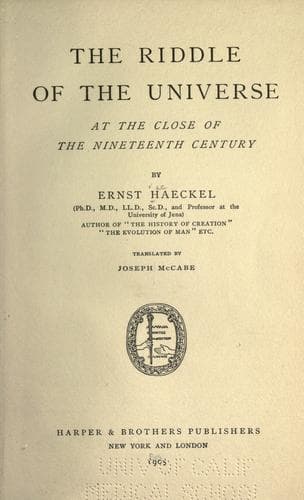
The Riddle of the Universe at the close of the nineteenth centuryHaeckel, Ernst
Religion
The Riddle of the Universe at the close of the nineteenth century
Haeckel, Ernst
Evolution; Monism; Religion and science; Soul
It is the despotism of the papacy that lent its darkest character to
the Middle Ages; it meant death to all freedom of mental life, decay
to all science, corruption to all morality. From the noble height to
which the life of the human mind had attained in classical antiquity,
in the centuries before Christ and the first century after Christ,
it soon sank, under the rule of the papacy, to a level which, in
respect of the knowledge of the truth, can only be termed barbarism.
It is often protested that other aspects of mental life--poetry and
architecture, scholastic learning and patristic philosophy--were richly
developed in the Middle Ages. But this activity was in the service of
the Church; it did not tend to the cultivation, but to the suppression,
of free mental research. The exclusive preparing for an unknown
eternity beyond the tomb, the contempt of nature, the withdrawal from
the study of it, which are essential elements of Christianity, were
urged as a sacred duty by the Roman hierarchy. It was not until the
beginning of the sixteenth century that a change for the better came in
with the Reformation.
It is impossible for us here to describe the pitiful retrogression
of culture and morality during the twelve centuries of the spiritual
despotism of Rome. It is very pithily expressed in a saying of the
greatest and the ablest of the Hohenzollerns; Frederick the Great
condensed his judgment in the phrase that the study of history led
one to think that from Constantine to the date of the Reformation the
whole world was insane. L. Büchner has given us an admirable, brief
description of this "period of insanity" in his work on _Religious
and Scientific Systems_. The reader who desires a closer acquaintance
with the subject would do well to consult the historical works of
Ranke, Draper, Kolb, Svoboda, etc. The truthful description of the
awful condition of the Christian Middle Ages, which is given by these
and other unprejudiced historians, is confirmed by all the reliable
sources of investigation, and by the historical monuments which
have come down from the saddest period of human history. Educated
Catholics, who are sincere truth-seekers, cannot be too frequently
recommended to study these historical sources for themselves. This is
the more necessary as ultramontane literature has still a considerable
influence. The old trick of deceiving the faithful by a complete
reversal of facts and an invention of miraculous circumstances is
still worked by it with great success. We will only mention Lourdes
and the "Holy Coat" of Trêves. The ultramontane professor of history
at Frankfurt, Johannes Janssen, affords a striking example of the
length they will go in distorting historical truth; his much-read works
(especially his _History of the German People since the Middle Ages_)
are marred by falsification to an incredible extent. The untruthfulness
of these Jesuitical productions is on a level with the credulity and
Public-domain text, read in full here on John Shaqi.
Reviews
Reviews
No reviews yet
Be the first to share your thoughts on this work.
Elsewhere in the archive
Join the Discussion
Join the discussion
Sign in to leave a comment or review.
Sign InorCreate an account