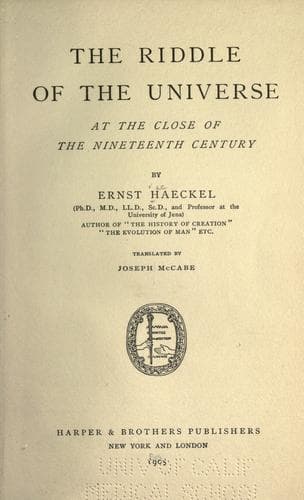
The Riddle of the Universe at the close of the nineteenth centuryHaeckel, Ernst
Religion
The Riddle of the Universe at the close of the nineteenth century
Haeckel, Ernst
Evolution; Monism; Religion and science; Soul
the uncritical judgment of the simple German nation that takes them for
gospel.
One of the most interesting of the historical facts which clearly prove
the evil of the ultramontane despotism is its vigorous and consistent
struggle with science. This was determined on, in principle, from the
very beginning of Christianity, inasmuch as it set faith above reason
and preached the blind subjection of the one to the other; that was
natural, seeing that our whole life on earth was held to be only a
preparation for the legendary life beyond, and thus scientific research
was robbed of any real value. The deliberate and successful attack on
science began in the early part of the fourth century, particularly
after the Council of Nicæa (327), presided over by Constantine--called
the "Great" because he raised Christianity to the position of a state
religion, and founded Constantinople, though a worthless character,
a false-hearted hypocrite, and a murderer. The success of the papacy
in its conflict with independent scientific thought and inquiry is
best seen in the distressing condition of science and its literature
during the Middle Ages. Not only were the rich literary treasures
that classical antiquity had bequeathed to the world destroyed for
the most part, or withdrawn from circulation, but the rack and the
stake insured the silence of every heretic--that is, every independent
thinker. If he did not keep his thoughts to himself, he had to look
forward to being burned alive, as was the fate of the great monistic
philosopher, Giordano Bruno, the reformer, John Huss, and more than a
hundred thousand other "witnesses to the truth." The history of science
in the Middle Ages teaches us on every page that independent thought
and empirical research were completely buried for twelve sad centuries
under the oppression of the omnipotent papacy.
Public-domain text, read in full here on John Shaqi.
Reviews
Reviews
No reviews yet
Be the first to share your thoughts on this work.
Elsewhere in the archive
Join the Discussion
Join the discussion
Sign in to leave a comment or review.
Sign InorCreate an account