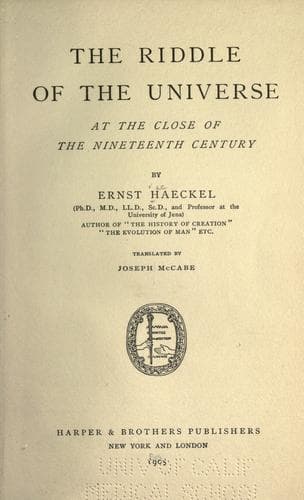
The Riddle of the Universe at the close of the nineteenth centuryHaeckel, Ernst
Religion
The Riddle of the Universe at the close of the nineteenth century
Haeckel, Ernst
Evolution; Monism; Religion and science; Soul
All that we esteem in true Christianity, in the sense of its founder
and of his noblest followers, and that we must endeavor to save from
the inevitable wreck of this great world religion for our new monistic
religion, lies on its ethical and social planes. The principles of
true humanism, the golden rule, the spirit of tolerance, the love
of man, in the best and highest sense of the word--all these true
graces of Christianity were not, indeed, first discovered and given
to the world by that religion, but were successfully developed in the
critical period when classical antiquity was hastening to its doom.
The papacy, however, has attempted to convert all those virtues into
the direct contrary, and still to hang out the sign of the old firm.
Instead of Christian charity, it introduced a fanatical hatred of the
followers of all other religions; with fire and sword it has pursued,
not only the heathen, but every Christian sect that dared resist the
imposition of ultramontane dogma. Tribunals for heretics were erected
all over Europe, yielding unnumbered victims, whose torments seemed
only to fill their persecutors, with all their Christian charity, with
a peculiar satisfaction. The power of Rome was directed mercilessly
for centuries against everything that stood in its way. Under the
notorious Torquemada (1481-98), in Spain alone eight thousand heretics
were burned alive and ninety thousand punished with the confiscation
of their goods and the most grievous ecclesiastical fines; in the
Netherlands, under the rule of Charles V., at least fifty thousand
men fell victims to the clerical bloodthirst. And while the heavens
resounded with the cry of the martyrs, the wealth of half the world was
pouring into Rome, to which the whole of Christianity paid tribute, and
the self-styled representatives of God on earth and their accomplices
(not infrequently Atheists themselves) wallowed in pleasure and vice
of every description. "And all these privileges," said the frivolous,
syphilitic Pope, Leo X., "have been secured to us by the fable of Jesus
Christ."
Public-domain text, read in full here on John Shaqi.
Reviews
Reviews
No reviews yet
Be the first to share your thoughts on this work.
Elsewhere in the archive
Join the Discussion
Join the discussion
Sign in to leave a comment or review.
Sign InorCreate an account