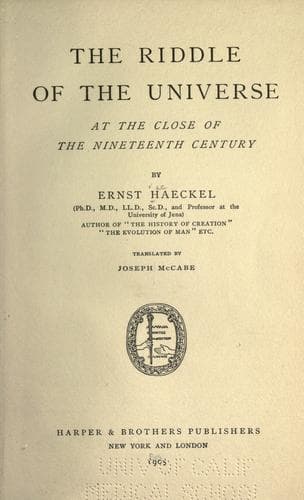
The Riddle of the Universe at the close of the nineteenth centuryHaeckel, Ernst
Religion
The Riddle of the Universe at the close of the nineteenth century
Haeckel, Ernst
Evolution; Monism; Religion and science; Soul
Yet, with all the discipline of the Church and the fear of God, the
condition of European society was pitiable. Feudalism, serfdom, the
grace of God, and the favor of the monks ruled the land; the poor
helots were only too glad to be permitted to raise their miserable
huts under the shadow of the castle or the cloister, their secular and
spiritual oppressors and exploiters. Even to-day we suffer from the
aftermath of these awful ages and conditions, in which there was no
question of care for science or higher mental culture save in rare
circumstances and in secret. Ignorance, poverty, and superstition
combined with the immoral operation of the law of celibacy, which
had been introduced in the eleventh century, to consolidate the
ever-growing power of the papacy. It has been calculated that there
were more than ten million victims of fanatical religious hatred during
this "Golden Age" of papal domination; and how many more million human
victims must be put to the account of celibacy, oral confession, and
moral constraint, the most pernicious and accursed institutions of
the papal despotism! Unbelieving philosophers, who have collected
disproofs of the existence of God, have overlooked one of the strongest
arguments in that sense--the fact that the Roman "Vicar of Christ"
could for twelve centuries perpetrate with impunity the most shameful
and horrible deeds "in the name of God."
III.--THE REFORMATION
The history of civilization, which we are so fond of calling "the
history of the world," enters upon its third period with the
Reformation of the Christian Church, just as its second period begins
with the founding of Christianity. With the Reformation begins the
new birth of fettered reason, the reawakening of science, which the
iron hand of the Christian papacy had relentlessly crushed for twelve
hundred years. At the same time the spread of general education had
already commenced, owing to the invention of printing about the
middle of the fifteenth century; and towards its close several great
events occurred, especially the discovery of America in 1492, which
prepared the way for the "renaissance" of science in company with
that of art. Indeed, certain very important advances were made in the
knowledge of nature during the first half of the sixteenth century,
which shook the prevailing system to its very foundations. Such were
the circumnavigation of the globe by Magellan in 1522, which afforded
empirical proof of its rotundity, and the founding of the new system of
the world by Copernicus in 1543.
Public-domain text, read in full here on John Shaqi.
Reviews
Reviews
No reviews yet
Be the first to share your thoughts on this work.
Elsewhere in the archive
Join the Discussion
Join the discussion
Sign in to leave a comment or review.
Sign InorCreate an account