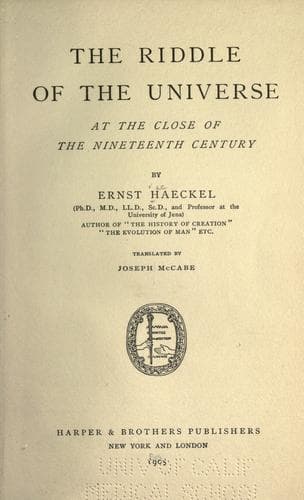
The Riddle of the Universe at the close of the nineteenth centuryHaeckel, Ernst
Religion
The Riddle of the Universe at the close of the nineteenth century
Haeckel, Ernst
Evolution; Monism; Religion and science; Soul
History teaches us that this ascetical morality that would scorn the
whole of nature had, as a natural consequence, the very opposite effect
to that it intended. Monasteries, the homes of chastity and discipline,
soon became dens of the wildest orgies; the sexual commerce of monks
and nuns has inspired shoals of novels, as it is so faithfully depicted
in the literature of the Renaissance. The cult of the "beautiful,"
which was then practised, was in flagrant contradiction with the
vaunted "abandonment of the world"; and the same must be said of the
pomp and luxury which soon developed in the immoral private lives of
the higher ecclesiastics and in the artistic decoration of Christian
churches and monasteries.
It may be objected that our view is refuted by the splendor of
Christian art, which, especially in the best days of the Middle Ages,
created works of undying beauty. The graceful Gothic cathedrals and
Byzantine basilicas, the hundreds of magnificent chapels, the thousands
of marble statues of saints and martyrs, the millions of fine pictures
of saints, of profoundly conceived representations of Christ and the
madonna--all are proofs of the development of a noble art in the Middle
Ages, which is unique of its kind. All these splendid monuments of
mediæval art are untouched in their high æsthetic value, whatever we
say of their mixture of truth and fancy. Yes; but what has all that
to do with the pure teaching of Christianity--with that religion of
sacrifice that turned scornfully away from all earthly parade and
glamour, from all material beauty and art; that made light of the life
of the family and the love of woman; that urged an exclusive concern as
to the immaterial goods of eternal life? The idea of a Christian art
is a contradiction in terms--a _contradictio in adjecto_. The wealthy
princes of the Church who fostered it were candidly aiming at very
different ideals, and they completely attained them. In directing the
whole interest and activity of the human mind in the Middle Ages to the
Christian Church and its distinctive art they were diverting it _from
nature_ and from the knowledge of the treasures that were hidden in it,
and would have conducted to independent science. Moreover, the daily
sight of the huge images of the saints and of the scenes of "sacred
history" continually reminded the faithful of the vast collection of
myths that the Church had made. The legends themselves were taught
and believed to be true narratives, and the stories of miracles to be
records of actual events. It cannot be doubted that in this respect
Christian art has exercised an immense influence on general culture,
and especially in the strengthening of Christian belief--an influence
which still endures throughout the entire civilized world.
Public-domain text, read in full here on John Shaqi.
Reviews
Reviews
No reviews yet
Be the first to share your thoughts on this work.
Elsewhere in the archive
Join the Discussion
Join the discussion
Sign in to leave a comment or review.
Sign InorCreate an account