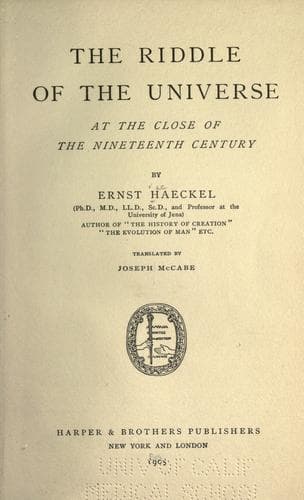
The Riddle of the Universe at the close of the nineteenth centuryHaeckel, Ernst
Religion
The Riddle of the Universe at the close of the nineteenth century
Haeckel, Ernst
Evolution; Monism; Religion and science; Soul
The diametrical opposite of this dominant Christian art is the new
artistic tendency which has been developed during the present century
in connection with science. The remarkable expansion of our knowledge
of nature, and the discovery of countless beautiful forms of life,
which it includes, have awakened quite a new æsthetic sense in our
generation, and thus given a new tone to painting and sculpture.
Numerous scientific voyages and expeditions for the exploration
of unknown lands and seas, partly in earlier centuries, but more
especially in the nineteenth, have brought to light an undreamed
abundance of new organic forms. The number of new species of animals
and plants soon became enormous, and among them (especially among the
lower groups that had been neglected before) there were thousands
of forms of great beauty and interest, affording an entirely new
inspiration for painting, sculpture, architecture, and technical
art. In this respect a new world was revealed by the great advance
of microscopic research in the second half of the century, and
especially by the discovery of the marvellous inhabitants of the
deep sea, which were first brought to light by the famous expedition
of the _Challenger_ (1872-76). Thousands of graceful radiolaria and
thalamophora, of pretty medusæ and corals, of extraordinary molluscs,
and crabs, suddenly introduced us to a wealth of hidden organisms
beyond all anticipation, the peculiar beauty and diversity of which
far transcend all the creations of the human imagination. In the
fifty large volumes of the account of the _Challenger_ expedition a
vast number of these beautiful forms are delineated on three thousand
plates; and there are millions of other lovely organisms described in
other great works that are included in the fast-growing literature of
zoology and botany of the last ten years. I began on a small scale to
select a number of these beautiful forms for more popular description
in my _Art Forms in Nature_ (1899).
However, there is now no need for long voyages and costly works to
appreciate the beauties of this world. A man needs only to keep his
eyes open and his mind disciplined. Surrounding nature offers us
everywhere a marvellous wealth of lovely and interesting objects of all
kinds. In every bit of moss and blade of grass, in every beetle and
butterfly, we find, when we examine it carefully, beauties which are
usually overlooked. Above all, when we examine them with a powerful
glass or, better still, with a good microscope, we find everywhere in
nature a new world of inexhaustible charms.
Public-domain text, read in full here on John Shaqi.
Reviews
Reviews
No reviews yet
Be the first to share your thoughts on this work.
Elsewhere in the archive
Join the Discussion
Join the discussion
Sign in to leave a comment or review.
Sign InorCreate an account