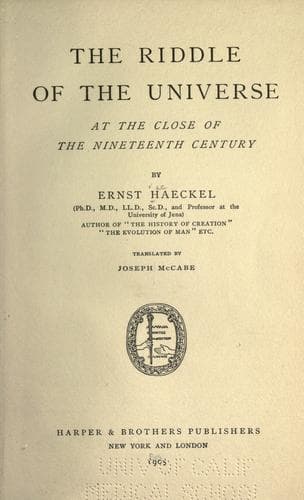
The Riddle of the Universe at the close of the nineteenth centuryHaeckel, Ernst
Religion
The Riddle of the Universe at the close of the nineteenth century
Haeckel, Ernst
Evolution; Monism; Religion and science; Soul
But the nineteenth century has not only opened our eyes to the æsthetic
enjoyment of the microscopic world; it has shown us the beauty of
the greater objects in nature. Even at its commencement it was the
fashion to regard the mountains as magnificent but forbidding, and
the sea as sublime but dreaded. At its close the majority of educated
people--especially they who dwell in the great cities--are delighted
to enjoy the glories of the Alps and the crystal splendor of the
glacier world for a fortnight every year, or to drink in the majesty
of the ocean and the lovely scenery of its coasts. All these sources
of the keenest enjoyment of nature have only recently been revealed
to us in all their splendor, and the remarkable progress we have
made in facility and rapidity of conveyance has given even the less
wealthy an opportunity of approaching them. All this progress in the
æsthetic enjoyment of nature--and, proportionately, in the scientific
understanding of nature--implies an equal advance in higher mental
development and, consequently, in the direction of our monistic
religion.
The opposite character of our _naturalistic_ century to that of the
_anthropistic_ centuries that preceded is especially noticeable in
the different appreciation and spread of illustrations of the most
diverse natural objects. In our own days a lively interest in artistic
work of that kind has been developed, which did not exist in earlier
ages; it has been supported by the remarkable progress of commerce
and technical art which have facilitated a wide popularization of
such illustrations. Countless illustrated periodicals convey along
with their general information a sense of the inexhaustible beauty of
nature in all its departments. In particular, landscape-painting has
acquired an importance that surpassed all imagination. In the first
half of the century one of our greatest and most erudite scientists,
Alexander Humboldt, had pointed out that the development of modern
landscape-painting is not only of great importance as an incentive
to the study of nature and as a means of geographical description,
but that it is to be commended in other respects as a noble educative
medium. Since that time the taste for it has considerably increased.
It should be the aim at every school to teach the children to enjoy
scenery at an early age, and to give them the valuable art of
imprinting on the memory by a drawing or water-color sketch.
Public-domain text, read in full here on John Shaqi.
Reviews
Reviews
No reviews yet
Be the first to share your thoughts on this work.
Elsewhere in the archive
Join the Discussion
Join the discussion
Sign in to leave a comment or review.
Sign InorCreate an account