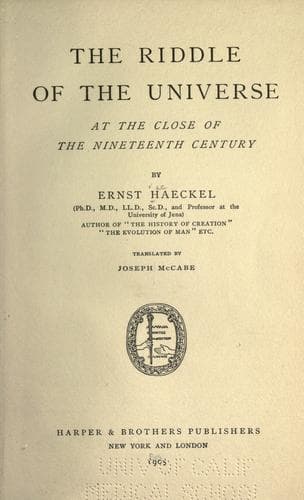
The Riddle of the Universe at the close of the nineteenth centuryHaeckel, Ernst
Religion
The Riddle of the Universe at the close of the nineteenth century
Haeckel, Ernst
Evolution; Monism; Religion and science; Soul
The infinite wealth of nature in what is beautiful and sublime offers
every man with open eyes and an æsthetic sense an incalculable sum of
choicest gifts. Still, however valuable and agreeable is the immediate
enjoyment of each single gift, its worth is doubled by a knowledge of
its meaning and its connection with the rest of nature. When Humboldt
gave us the "outline of a physical description of the world" in his
magnificent _Cosmos_ forty years ago, and when he combined scientific
and æsthetic consideration so happily in his standard _Prospects of
Nature_, he justly indicated how closely the higher enjoyment of nature
is connected with the "scientific establishment of cosmic laws," and
that the conjunction of the two serves to raise human nature to a
higher stage of perfection. The astonishment with which we gaze upon
the starry heavens and the microscopic life in a drop of water, the awe
with which we trace the marvellous working of energy in the motion of
matter, the reverence with which we grasp the universal dominance of
the law of substance throughout the universe--all these are part of our
emotional life, falling under the heading of "natural religion."
This progress of modern times in knowledge of the true and enjoyment
of the beautiful expresses, on the one hand, a valuable element of our
monistic religion, but is, on the other hand, in fatal opposition to
Christianity. For the human mind is thus made to live on this side of
the grave; Christianity would have it ever gaze beyond. Monism teaches
that we are perishable children of the earth, who for one or two,
or, at the most, three generations, have the good fortune to enjoy
the treasures of our planet, to drink of the inexhaustible fountain
of its beauty, and to trace out the marvellous play of its forces.
Christianity would teach us that the earth is "a vale of tears," in
which we have but a brief period to chasten and torment ourselves in
order to merit the life of eternal bliss beyond. Where this "beyond"
is, and of what joys the glory of this eternal life is compacted, no
revelation has ever told us. As long as "heaven" was thought to be the
blue vault that hovers over the disk of our planet, and is illumined
by the twinkling light of a few thousand stars, the human imagination
could picture to itself the ambrosial banquets of the Olympic gods
above or the laden tables of the happy dwellers in Valhalla. But now
all these deities and the immortal souls that sat at their tables are
"houseless and homeless," as David Strauss has so ably described; for
we know from astrophysical science that the immeasurable depths of
space are filled with a prosaic ether, and that millions of heavenly
bodies, ruled by eternal laws of iron, rush hither and thither in the
great ocean, in their eternal rhythm of life and death.
Public-domain text, read in full here on John Shaqi.
Reviews
Reviews
No reviews yet
Be the first to share your thoughts on this work.
Elsewhere in the archive
Join the Discussion
Join the discussion
Sign in to leave a comment or review.
Sign InorCreate an account