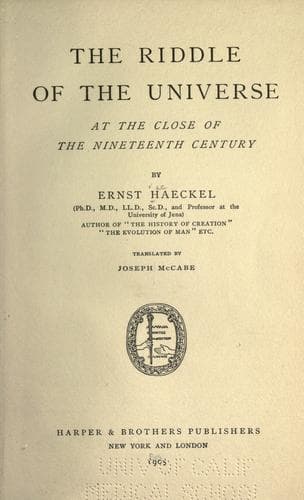
The Riddle of the Universe at the close of the nineteenth centuryHaeckel, Ernst
Religion
The Riddle of the Universe at the close of the nineteenth century
Haeckel, Ernst
Evolution; Monism; Religion and science; Soul
The places of devotion, in which men seek the satisfaction of their
religious emotions and worship the objects of their reverence, are
regarded as sacred "churches." The pagodas of Buddhistic Asia, the
Greek temples of classical antiquity, the synagogues of Palestine,
the mosques of Egypt, the Catholic cathedrals of the south, and the
Protestant cathedrals of the north, of Europe--all these "houses of
God" serve to raise man above the misery and the prose of daily life,
to lift him into the sacred, poetic atmosphere of a higher, ideal
world. They attain this end in a thousand different ways, according
to their various forms of worship and their age. The modern man who
"has science and art"--and, therefore, "religion"--needs no special
church, no narrow, enclosed portion of space. For through the length
and breadth of free nature, wherever he turns his gaze, to the whole
universe or to any single part of it, he finds, indeed, the grim
"struggle for life," but by its side are ever "the good, the true, and
the beautiful"; his church is commensurate with the whole of glorious
nature. Still, there will always be men of special temperament who will
desire to have decorated temples or churches as places of devotion
to which they may withdraw. Just as the Catholics had to relinquish a
number of churches to the Reformation in the sixteenth century, so a
still larger number will pass over to "free societies" of monists in
the coming years.
CHAPTER XIX
OUR MONISTIC ETHICS
Monistic and Dualistic Ethics--Contradiction of Pure and
Practical Reason in Kant--His Categorical Imperative--The
Neo-Kantians--Herbert Spencer--Egoism and Altruism--Equivalence
of the Two Instincts--The Fundamental Law of Ethics: the Golden
Rule--Its Antiquity--Christian Ethics--Contempt of Self, the
Body, Nature, Civilization, the Family, Woman--Roman Catholic
Ethics--Immoral Results of Celibacy--Necessity for the Abolition of
the Law of Celibacy, Oral Confession, and Indulgences--State and
Church--Religion a Private Concern--Church and School--State and
School--Need of School Reform
The practical conduct of life makes a number of definite ethical claims
on a man which can only be duly and naturally satisfied when they are
in complete harmony with his view of the world. In accordance with this
fundamental principle of our monistic philosophy, our whole system of
ethics must be rationally connected with the unified conception of the
cosmos which we have formed by our advanced knowledge of the laws of
nature. Just as the infinite universe is one great whole in the light
of our monistic teaching, so the spiritual and moral life of man is
a part of this cosmos, and our naturalistic ordering of it must also
be monistic. There are not two different, separate worlds--the one
physical and material, and the other moral and immaterial.
Public-domain text, read in full here on John Shaqi.
Reviews
Reviews
No reviews yet
Be the first to share your thoughts on this work.
Elsewhere in the archive
Join the Discussion
Join the discussion
Sign in to leave a comment or review.
Sign InorCreate an account