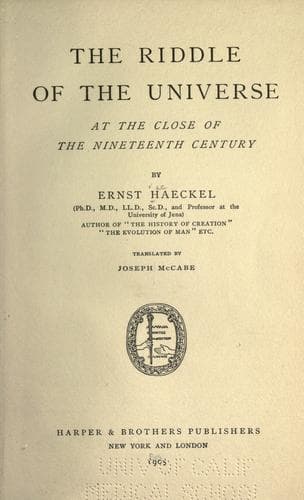
The Riddle of the Universe at the close of the nineteenth centuryHaeckel, Ernst
Religion
The Riddle of the Universe at the close of the nineteenth century
Haeckel, Ernst
Evolution; Monism; Religion and science; Soul
The great majority of philosophers and theologians still hold the
contrary opinion. They affirm, with Kant, that the moral world is quite
independent of the physical, and is subject to very different laws;
hence a man's conscience, as the basis of his moral life, must also be
quite independent of our scientific knowledge of the world, and must be
based rather on his religious faith. On that theory the study of the
moral world belongs to _practical_ reason, while that of nature, or of
the physical world, is referred to _pure_ or theoretical reason. This
unequivocal and conscious dualism of Kant's philosophy was its greatest
defect; it has caused, and still causes, incalculable mischief. First
of all the "critical Kant" had built up the splendid and marvellous
palace of pure reason, and convincingly proved that the three great
central dogmas of metaphysics--a personal God, free will, and the
immortal soul--had no place whatever in it, and that no rational proof
could be found of their reality. Afterwards, however, the "dogmatic
Kant" superimposed on this true crystal palace of _pure_ reason the
glittering, ideal castle in the air of _practical_ reason, in which
three imposing church-naves were designed for the accommodation of
those three great mystic divinities. When they had been put out at the
front door by rational knowledge they returned by the back door under
the guidance of irrational faith.
The cupola of his great cathedral of faith was crowned by Kant with his
curious idol, the famous "categorical imperative." According to it,
the demand of the universal moral law is unconditional, independent of
any regard to actuality or potentiality. It runs: "Act at all times in
such wise that the maxim (or the subjective law of thy will) may hold
good as a principle of a universal law." On that theory all normal men
would have the same sense of duty. Modern anthropology has ruthlessly
dissipated that pretty dream; it has shown that conceptions of duty
differ even more among uncivilized than among civilized nations. All
the actions and customs which we regard as sins or loathsome crimes
(theft, fraud, murder, adultery, etc.) are considered by other nations
in certain circumstances to be virtues, or even sacred duties.
Public-domain text, read in full here on John Shaqi.
Reviews
Reviews
No reviews yet
Be the first to share your thoughts on this work.
Elsewhere in the archive
Join the Discussion
Join the discussion
Sign in to leave a comment or review.
Sign InorCreate an account