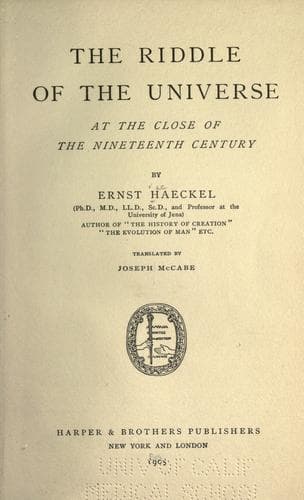
The Riddle of the Universe at the close of the nineteenth centuryHaeckel, Ernst
Religion
The Riddle of the Universe at the close of the nineteenth century
Haeckel, Ernst
Evolution; Monism; Religion and science; Soul
The study of the heavens is the oldest, the study of man the youngest,
of the sciences. With regard to himself and the character of his being
man only obtained a clear knowledge in the second half of the present
century; with regard to the starry heavens, the motions of the planets,
and so on, he had acquired astonishing information forty-five hundred
years ago. The ancient Chinese, Hindoos, Egyptians, and Chaldæans in
the distant East knew more of the science of the spheres than the
majority of educated Christians did in the West four thousand years
after them. An eclipse of the sun was astronomically observed in China
in the year 2697 B.C., and the plane of the ecliptic was determined
by means of a gnome eleven hundred years B.C., while Christ himself
had no knowledge whatever of astronomy--indeed, he looked out upon
heaven and earth, nature and man, from the very narrowest geocentric
and anthropocentric point of view. The greatest advance of astronomy
is generally, and rightly, said to be the founding of the heliocentric
system of Copernicus, whose famous work, _De Revolutionibus Orbium
Celestium_, of itself caused a profound revolution in the minds of
thoughtful men. In overthrowing the Ptolemaic system, he destroyed the
foundation of the Christian theory, which regarded the earth as the
centre of the universe and man as the godlike ruler of the earth. It
was natural, therefore, that the Christian clergy, with the pope at its
head, should enter upon a fierce struggle with the invaluable discovery
of Copernicus. Yet it soon cleared a path for itself, when Kepler and
Galileo grounded on it their true "mechanics of the heavens," and
Newton gave it a solid foundation by his theory of gravitation (1686).
A further great advance, comprehending the entire universe, was the
application of the idea of evolution to astronomy. It was done by
the youthful Kant in 1755; in his famous general natural history and
theory of the heavens he undertook the discussion, not only of the
"constitution," but also of the "mechanical origin" of the whole
world-structure on Newtonian principles. The splendid _Système du
Monde_ of Laplace, who had independently come to the same conclusions
as Kant on the world-problem, gave so firm a basis to this new
_Mécanique Céleste_ in 1796 that it looked as if nothing entirely
new of equal importance was left to be discovered in the nineteenth
century. Yet here again it had the honor of opening out entirely
new paths and infinitely enlarging our outlook on the universe. The
invention of photography and photometry, and especially of spectral
analysis (in 1860 by Bunsen and Kirchoff), introduced physics and
chemistry into astronomy and led to cosmological conclusions of the
utmost importance. It was now made perfectly clear that matter is
the same throughout the universe, and that its physical and chemical
properties in the most distant stars do not differ from those of the
earth under our feet.
Public-domain text, read in full here on John Shaqi.
Reviews
Reviews
No reviews yet
Be the first to share your thoughts on this work.
Elsewhere in the archive
Join the Discussion
Join the discussion
Sign in to leave a comment or review.
Sign InorCreate an account