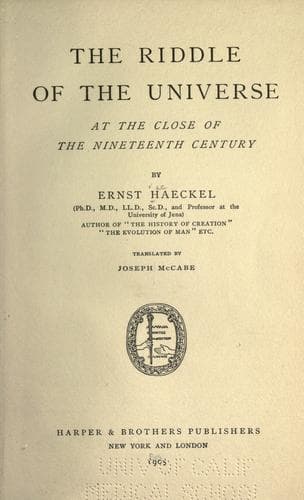
The Riddle of the Universe at the close of the nineteenth centuryHaeckel, Ernst
Religion
The Riddle of the Universe at the close of the nineteenth century
Haeckel, Ernst
Evolution; Monism; Religion and science; Soul
The monistic conviction, which we thus arrived at, of the physical
and chemical unity of the entire cosmos is certainly one of the most
valuable general truths which we owe to astrophysics, the new branch
of astronomy which is honorably associated with the name of Friedrich
Zöllner. Not less important is the clear knowledge we have obtained
that the same laws of mechanical development that we have on the
earth rule throughout the infinite universe. A vast, all-embracing
metamorphosis goes on continuously in all parts of the universe,
just as it is found in the geological history of the earth; it can
be traced in the evolution of its living inhabitants as surely as in
the history of peoples or in the life of each human individual. In
one part of space we perceive, with the aid of our best telescopes,
vast nebulæ of glowing, infinitely attenuated gas; we see in them the
embryos of heavenly bodies, billions of miles away, in the first stage
of their development. In some of these "stellar embryos" the chemical
elements do not seem to be differentiated yet, but still buried in the
homogeneous primitive matter (_prothyl_) at an enormous temperature
(calculated to run into millions of degrees); it is possible that the
original basic "substance" (_vide_ p. 229) is not yet divided into
ponderable and imponderable matter. In other parts of space we find
stars that have cooled down into glowing fluid, and yet others that
are cold and rigid; we can tell their stage of evolution approximately
by their color. We find stars that are surrounded with rings and moons
like Saturn; and we recognize in the luminous ring of the nebula the
embryo of a new moon, which has detached itself from the mother-planet,
just as the planet was released from the sun.
Public-domain text, read in full here on John Shaqi.
Reviews
Reviews
No reviews yet
Be the first to share your thoughts on this work.
Elsewhere in the archive
Join the Discussion
Join the discussion
Sign in to leave a comment or review.
Sign InorCreate an account