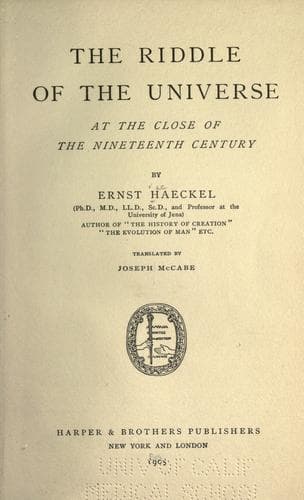
The Riddle of the Universe at the close of the nineteenth centuryHaeckel, Ernst
Religion
The Riddle of the Universe at the close of the nineteenth century
Haeckel, Ernst
Evolution; Monism; Religion and science; Soul
Many of the stars, the light of which has taken thousands of years to
reach us, are certainly suns like our own mother-sun, and are girt
about with planets and moons, just as in our own solar system. We
are justified in supposing that thousands of these planets are in a
similar stage of development to that of our earth--that is, they have
arrived at a period when the temperature at the surface lies between
the freezing and boiling point of water, and so permits the existence
of water in its liquid condition. That makes it possible that carbon
has entered into the same complex combinations on those planets as
it has done on our earth, and that from its nitrogenous compounds
protoplasm has been evolved--that wonderful substance which alone,
as far as our knowledge goes, is the possessor of organic life. The
monera (for instance, chromacea and bacteria), which consist only of
this primitive protoplasm, and which arise by spontaneous generation
from these inorganic nitrocarbonates, may thus have entered upon the
same course of evolution on many other planets as on our own; first of
all, living cells of the simplest character would be formed from their
homogeneous protoplasmic body by the separation of an inner nucleus
from the outer cell body (cytostoma). Further, the analogy that we
find in the life of all cells--whether plasmodomous plant-cells or
plasmophagous animal-cells--justifies the inference that the further
course of organic evolution on these other planets has been analogous
to that of our own earth--always, of course, given the same limits of
temperature which permit water in a liquid form. In the glowing liquid
bodies of the stars, where water can only exist in the form of steam,
and on the cold extinct suns, where it can only be in the shape of ice,
such organic life as we know is impossible.
The similarity of phylogeny, or the analogy of organic evolution,
which we may thus assume in many stars which are at the same stage of
biogenetic development, naturally opens out a wide field of brilliant
speculation to the constructive imagination. A favorite subject for
such speculation has long been the question whether there are men, or
living beings like ourselves, perhaps much more highly developed, in
other planets? Among the many works which have sought to answer the
question, those of Camille Flammarion, the Parisian astronomer, have
recently been extremely popular; they are equally distinguished by
exuberant imagination and brilliant style, and by a deplorable lack
of critical judgment and biological knowledge. We may condense in the
following thesis the present condition of our knowledge on the subject:
Public-domain text, read in full here on John Shaqi.
Reviews
Reviews
No reviews yet
Be the first to share your thoughts on this work.
Elsewhere in the archive
Join the Discussion
Join the discussion
Sign in to leave a comment or review.
Sign InorCreate an account