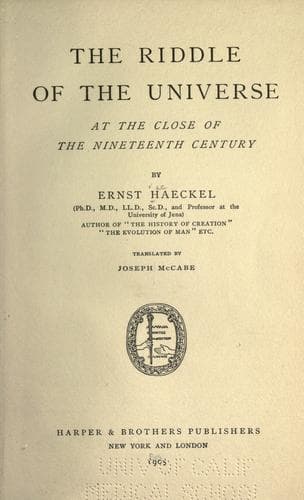
The Riddle of the Universe at the close of the nineteenth centuryHaeckel, Ernst
Religion
The Riddle of the Universe at the close of the nineteenth century
Haeckel, Ernst
Evolution; Monism; Religion and science; Soul
I. It is very probable that a similar biogenetic process to that of our
own earth is taking place on some of the other planets of our solar
system (Mars and Venus), and on many planets of other solar systems;
first simple monera are formed by spontaneous generation, and from
these arise unicellular protists (first plasmodomous primitive plants,
and then plasmophagous primitive animals).
II. It is very probable that from these unicellular protists arise,
in the further course of evolution, first social cell-communities
(coenobia), and subsequently tissue-forming plants and animals
(metaphyta and metazoa).
III. It is also very probable that thallophyta (algæ and fungi) were
the first to appear in the plant-kingdom, then diaphyta (mosses and
ferns), finally anthophyta (gymnosperm and angiosperm flowering plants).
IV. It is equally probable that the biogenetic process took a similar
course in the animal kingdom--that from the blastæads (catallacta)
first gastræads were formed, and from these lower animal forms
(coelenteria) higher organisms (coelomaria) were afterwards evolved.
V. On the other hand, it is very questionable whether the different
stems of these higher animals (and those of the higher plants as well)
run through the same course of development on other planets as on our
earth.
VI. In particular, it is wholly uncertain whether there are vertebrates
on other planets, and whether, in the course of their phyletic
development, taking millions of years, mammals are formed as on earth,
reaching their highest point in the formation of man; in such an event,
millions of changes would have to be just the same in both cases.
VII. It is much more probable, on the contrary, that other planets
have produced other types of the higher plants and animals, which are
unknown on our earth; perhaps from some higher animal stem, which is
superior to the vertebrate in formation, higher beings have arisen who
far transcend us earthly men in intelligence.
VIII. The possibility of our ever entering into direct communication
with such inhabitants of other planets seems to be excluded by the
immense distance of our earth from the other heavenly bodies, and the
absence of the requisite atmosphere in the intervening space, which
contains only ether.
Public-domain text, read in full here on John Shaqi.
Reviews
Reviews
No reviews yet
Be the first to share your thoughts on this work.
Elsewhere in the archive
Join the Discussion
Join the discussion
Sign in to leave a comment or review.
Sign InorCreate an account