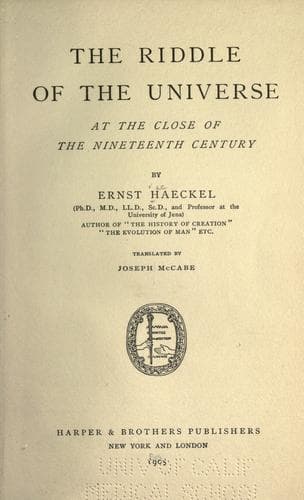
The Riddle of the Universe at the close of the nineteenth centuryHaeckel, Ernst
Religion
The Riddle of the Universe at the close of the nineteenth century
Haeckel, Ernst
Evolution; Monism; Religion and science; Soul
But while many of the stars are probably in a similar stage of
biogenetic development to that of our earth (for the last one hundred
million years at least), others have advanced far beyond this stage,
and, in their planetary old age, are hastening towards their end--the
same end that inevitably awaits our own globe. The radiation of heat
into space gradually lowers the temperature until all the water is
turned into ice; that is the end of all organic life. The substance
of the rotating mass contracts more and more; the rapidity of its
motion gradually falls off. The orbits of the planets and of their
moons grow narrower. At length the moons fall upon the planets, and
the planets are drawn into the sun that gave them birth. The collision
again produces an enormous quantity of heat. The pulverized mass of the
colliding bodies is distributed freely through infinite space, and the
eternal drama of sun-birth begins afresh.
The sublime picture which modern astrophysics thus unveils before the
mind's eye shows us an eternal birth and death of countless heavenly
bodies, a periodic change from one to the other of the different
cosmogenetic conditions, which we observe side by side in the universe.
While the embryo of a new world is being formed from a nebula in
one corner of the vast stage of the universe, another has already
condensed into a rotating sphere of liquid fire in some far distant
spot; a third has already cast off rings at its equator, which round
themselves into planets; a fourth has become a vast sun whose planets
have formed a secondary retinue of moons, and so on. And between them
are floating about in space myriads of smaller bodies, meteorites,
or shooting-stars, which cross and recross the paths of the planets
apparently like lawless vagabonds, and of which a great number fall
onto the planets every day. Thus there is a continuous but slow change
in the velocities and the orbits of the revolving spheres. The frozen
moons fall onto the planets, the planets onto their suns. Two distant
suns, perhaps already stark and cold, rush together with inconceivable
force and melt away into nebulous clouds. And such prodigious heat
is generated by the collision that the nebula is once more raised to
incandescence, and the old drama begins again. Yet in this "perpetual
motion" the infinite substance of the universe, the sum total of its
matter and energy, remains eternally unchanged, and we have an eternal
repetition in infinite time of the periodic dance of the worlds, the
metamorphosis of the cosmos that ever returns to its starting-point.
Over all rules the law of substance.
II.--PROGRESS OF GEOLOGY
Public-domain text, read in full here on John Shaqi.
Reviews
Reviews
No reviews yet
Be the first to share your thoughts on this work.
Elsewhere in the archive
Join the Discussion
Join the discussion
Sign in to leave a comment or review.
Sign InorCreate an account