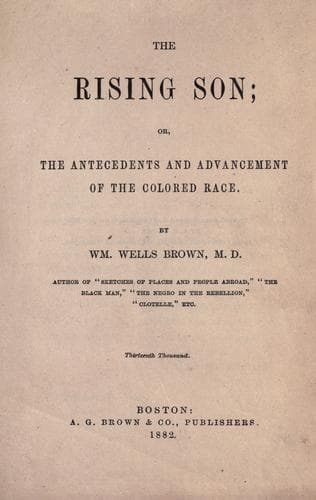
The Rising Son; or, the Antecedents and Advancement of the Colored RaceBrown, William Wells
History
The Rising Son; or, the Antecedents and Advancement of the Colored Race
Brown, William Wells
African Americans -- Biography; African Americans -- History; Black race; Slavery -- United States
He at once set himself vigorously to work to remedy the numerous
evils which had grown up under the administration of his ignorant,
narrow-minded, and cruel predecessor, and became exceedingly popular.
He established numerous schools in all parts of the Republic, and
gave every encouragement to agricultural and industrial enterprise
generally. In 1861, he concluded a concordat with the Pope, creating
Hayti an Archbishopric. Humane in his disposition, enlightened and
liberal in his views, and a steady friend of progress, his rule, at one
time, promised to be a long and prosperous one.
Geffrard was in color a _griffe_, and was fifty-two years of age when
called to the presidency of Hayti. He was of middle height, slim in
figure, of a pleasing countenance, sparkling eye, gray hair, limbs
supple by bodily exercise, a splendid horseman, and liberal to the
arts, even to extravagance. Possessing a polished education, he was
gentlemanly in his conversation and manners. Soon after assuming the
presidency, he resolved to encourage immigration, and issued an address
to the colored Americans, which in point of sympathy and patriotic
feeling for his race, has never been surpassed by any man living or
dead.
It may be set down as a truism, that slavery, proscription,
and oppression are poor schools in which to train independent,
self-respecting freemen. Individuals so trained are apt to have all
their aspirations, aims, ends, and objects in life on a level with the
low, grovelling, and servile plane of a slavish and dependent mind; or
if by chance that mind has grown restless under its fetters, and sighs
for enfranchisement and liberty, it is apt to rush to the other extreme
in its desires, and is led to covet those positions for which it has
no proper qualifications whatever. The bent of the slavery-disciplined
mind is either too low or too high. It cannot remain in equilibrium. It
either cringes with all the dastard servility of the slave, or assumes
the lordly airs of a cruel and imperious despot.
These things, therefore, being true of the victims of abject servitude,
we have herein the key to the failure of the colored emigration to
Hayti.
At the invitation of President Geffrard, in 1861, some of the colored
citizens of the United States did accept the invitation and went out;
but it would have been better for them and for Hayti had they remained
at home. The majority of the emigrants ventured on the voyage to Hayti,
because a free passage was given them by Geffrard; and the offer of the
Haytian government to supply the emigrants with provisions until they
could raise a crop, was a bait which these idlers could not withstand.
Men who had been failures in their own country, could scarcely be
expected to meet with success by merely a trip across the sea.
Public-domain text, read in full here on John Shaqi.
Reviews
Reviews
No reviews yet
Be the first to share your thoughts on this work.
Elsewhere in the archive
Join the Discussion
Join the discussion
Sign in to leave a comment or review.
Sign InorCreate an account