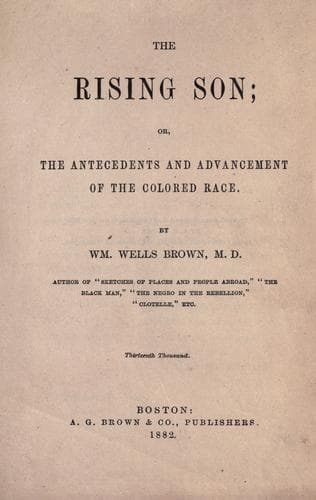
The Rising Son; or, the Antecedents and Advancement of the Colored RaceBrown, William Wells
History
The Rising Son; or, the Antecedents and Advancement of the Colored Race
Brown, William Wells
African Americans -- Biography; African Americans -- History; Black race; Slavery -- United States
What Hayti needed were men with stout hearts and hard hands, fitted for
an agricultural life, determined upon developing the resources of the
country. Men of the above type are to be found in our land, but they
can easily make a living here, and have no cause to emigrate.
The liberal offer of the Haytian president to Americans and other
blacks to come to the Island, and his general progressive efforts to
elevate his people, were not appreciated by the Haytians, and the
spirit of revolution which had so long governed the Island, soon began
to manifest itself.
The several rebellions against the authority of President Geffrard, of
Hayti, at length culminated in his overthrow and expulsion from the
Island, and the elevation of his old enemy, Salnave, to the presidency.
The rebellion, which was headed by Salnave, was begun in 1865. The
rebels seized and held the town of Cape Haytian for several months,
and were only finally driven out on its bombardment by the English
man-of-war, Bull Dog, commanded by Captain Wake. Salnave was forced to
leave Hayti and take refuge in St. Domingo. Captain Wake was called by
the British government, and cashiered for his attack on Cape Haytian.
In his exile Salnave continued his efforts to revolutionize the
country, and found many adherents, but few opportunities for an
uprising. An attempt was made by his friends at Port au Prince on
February 1, 1867; but Geffrard had been forewarned, and this attempt
failed, and the ringleaders were captured and shot. The revolutionists
did not despair, however, and on the night of February 22d a more
successful effort was made; Geffrard was driven to seek safety in
flight, and abdicating the presidency, went into exile in Jamaica. A
Provisional Government was appointed, and Salnave, whom the people
hailed as the “Garibaldi of Hayti,” and the “Deliverer of the People,”
was appointed President on April 26, 1867. He however insisted that he
would not accept the presidency except at the hands of the people. An
election was therefore ordered and held. There were no rival candidates
in the field, the other most distinguished participants in the
revolution, Generals Nissage and Chevallier, conceding the presidential
chair to Salnave with great good-will. He was unanimously elected, and
on Sunday, May 12, was sworn into office.
CHAPTER XXV.
SALNAVE AS PRESIDENT OF HAYTI.
President Salnave was a native of Cape Haytian, and was forty-one
years of age when elevated to power. He was the son of French and
Negro parents. He entered the army of Hayti in early youth, and was a
major under Geffrard when the empire was overthrown. While holding the
same commission under the Republic, Salnave projected the rebellion
of 1865, and seized Cape Haytian, from which he was driven, as we
have described. He was said to be a man of unusual intelligence, of
progressive and liberal ideas, great energy of character, and brilliant
results were expected from his administration.
Public-domain text, read in full here on John Shaqi.
Reviews
Reviews
No reviews yet
Be the first to share your thoughts on this work.
Elsewhere in the archive
Join the Discussion
Join the discussion
Sign in to leave a comment or review.
Sign InorCreate an account