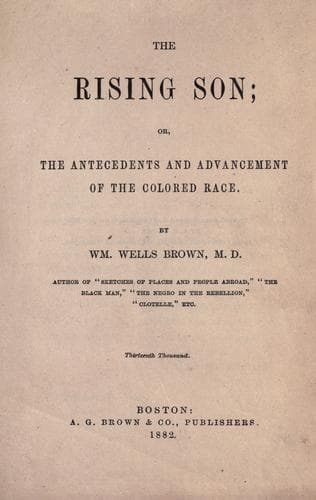
The Rising Son; or, the Antecedents and Advancement of the Colored RaceBrown, William Wells
History
The Rising Son; or, the Antecedents and Advancement of the Colored Race
Brown, William Wells
African Americans -- Biography; African Americans -- History; Black race; Slavery -- United States
However, obtaining supreme power by force, so common in Hayti, any
one could see that Salnave’s government would be of short duration.
The same influences as some of the men who aided him in driving out
Geffrard, soon began secretly to work against the new president, and
on the 18th of December, 1869, Salnave found himself shut up in his
capital, and surrounded on all sides by his most bitter enemies. At
last, on the 8th of January, 1870, the Haytian president sought safety
in flight, but was captured by President Cabral, of Dominica, into
whose government Salnave had taken refuge.
Delivered up to his own government by the Dominican president, Salnave
was tried for high treason, condemned and shot. In personal appearance
the defeated chief was a fine representative of the race. He was brown
in complexion, hair black, soft, and wavy, education good, for the
West Indies. Salnave was high-tempered, heedless, and even cruel. He
was succeeded in the government of Hayti by General Nissage Saget, who
seems to have the confidence of the people, and whom, it is hoped, he
will have the power to unite.
CHAPTER XXVI.
JAMAICA.
Jamaica, the chief of the British West India Islands, was discovered by
Columbus on his second voyage, in May, 1494, and was taken from Spain
by the English in May, 1655, during the reign of Oliver Cromwell. It
thus became an appendage to the British crown, after it had been in the
possession of Spain for one hundred and forty-six years. The number of
slaves on the Island at this time was about fifteen hundred.
Morgan, a notorious pirate and buccaneer, was knighted and made
governor of the Island in 1670. Lord Vaughan succeeded Morgan, and
under his administration the African Company was formed, and the
slave-trade legalized; Africans were imported in large numbers, and the
development of the natural resources of Jamaica greatly increased the
wealth of the planters.
The number of slaves annually imported into the Island amounted to
sixteen thousand,[42] so that within thirty years the slave population
had increased from ninety-nine thousand to upwards of two hundred
thousand, whilst the total numerical strength of the whites did not
exceed sixteen thousand.
From this time down to the year 1832, it presented a succession of
wars, usurpations, crimes, misery, and vice; nor in this desert of
human wretchedness is there one green spot on which the mind of a
philanthropist would love to dwell; all is one revolting scene of
infamy, bloodshed, and unmitigated woe; of insecure peace and open
disturbance; of the abuse of power, and of the reaction of misery
against oppression. In 1832 an insurrection of the slaves occurred,
by which the lives of seven hundred slaves were sacrificed, and an
expense, including property destroyed, of one hundred and sixty-two
thousand pounds sterling.
Public-domain text, read in full here on John Shaqi.
Reviews
Reviews
No reviews yet
Be the first to share your thoughts on this work.
Elsewhere in the archive
Join the Discussion
Join the discussion
Sign in to leave a comment or review.
Sign InorCreate an account