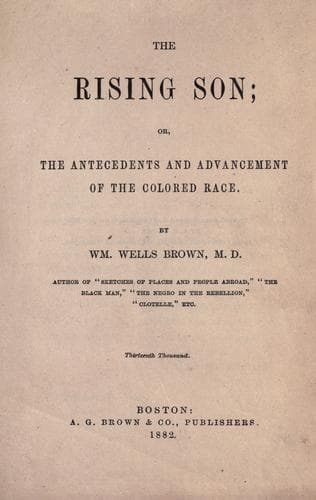
The Rising Son; or, the Antecedents and Advancement of the Colored RaceBrown, William Wells
History
The Rising Son; or, the Antecedents and Advancement of the Colored Race
Brown, William Wells
African Americans -- Biography; African Americans -- History; Black race; Slavery -- United States
The total importation of slaves from the conquest of the Island by the
English to 1805, amounted to eight hundred and fifty thousand, and this
added to forty thousand brought by the Spaniards, made an aggregate of
eight hundred and ninety thousand, exclusive of all births, in three
hundred years. The influence which the system of slavery spread over
the community in Jamaica and the rest of the British West Indies, was
not less demoralizing than in Hayti and the other islands.
Crimes which in European countries would have been considered and
treated as a wanton insult to society at large, did not exclude the
parties from the pale of respectable society, or generally operate to
their disadvantage among the female portion of the community.
The reckless destroyers of female innocence and happiness united in
the dance, mingled in public entertainments, and were admitted at the
social board, and were on terms of intimacy with the younger branches
of families.[43]
The intermediate colors between the whites[44] and pure blacks, were
denominated as follows: A Sambo is the offspring of a mulatto woman by
a black man; a mulatto is the child of a black woman and white man; a
quadroon is the offspring of a mulatto by a white man, and a mestee
is that of a quadroon woman by a white man. The offspring of a female
mestee by a white man being above the third in lineal descent from the
Negro ancestor, was white, in the estimation of the law, and enjoyed
all the privileges and immunities of Her Majesty’s white subjects; but
all the rest, whether mulattoes, quadroons, or mestees, were considered
by the law as mulattoes or persons of color.
Although the people of Jamaica represented to the home government that
the slaves were satisfied and happy, and would not accept their freedom
were it offered them, a revolt of the blacks took place in 1832.
More than fifty thousand were engaged in this effort to obtain the
long-wished-for boon.
The man with whom the insurrection originated,--Samuel Sharp,--was
a slave, and a member of the Baptist Church in Montego Bay. He was
born in slavery, but he had never felt anything of the bitterness of
slavery. He was born in a family that treated him indulgently; he was
a pet, and was brought up as the playmate of the juvenile members of
the family, and had opportunities of learning to read and for mental
cultivation, to which very few of his fellow-slaves had access; and
Sharp, above all this, was possessed of a mind worthy of any man, and
of oratorical powers of no common order.
Public-domain text, read in full here on John Shaqi.
Reviews
Reviews
No reviews yet
Be the first to share your thoughts on this work.
Elsewhere in the archive
Join the Discussion
Join the discussion
Sign in to leave a comment or review.
Sign InorCreate an account