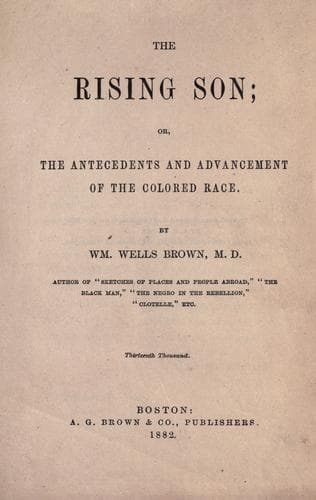
The Rising Son; or, the Antecedents and Advancement of the Colored RaceBrown, William Wells
History
The Rising Son; or, the Antecedents and Advancement of the Colored Race
Brown, William Wells
African Americans -- Biography; African Americans -- History; Black race; Slavery -- United States
Sharp determined to free himself and his fellow-slaves. I do not know
whether he was himself deceived, or whether he knowingly deceived
his fellow-conspirators; but he persuaded a large number of them to
believe that the British government had made them free, and that their
owners were keeping them in slavery, in opposition to the wishes of
the authorities in England. It so happened, that, just at that time,
the planters themselves were pursuing a course which favored Sharp’s
proceedings directly. They were holding meetings through the length and
breadth of the Island, protesting against the interference of the home
government with their property, passing very inflammatory resolutions,
and threatening that they would transfer their allegiance to the United
States, in order that they might perpetuate their interest in their
slaves.
The insurrection was suppressed, and about two thousand of the slaves
were put to death. This effort of the bondmen to free themselves,
gave a new impetus to the agitation of the abolition movement, which
had already begun under the auspices of Buxton, Allen, Brougham, and
George Thompson, the successors of Clarkson, Wilberforce, Sharp, and
Macaulay; and the work went bravely on. Elizabeth Heyrick, feeling that
the emancipation of the slave could never be effected by gradual means,
raised the cry of “Immediate emancipation.” She wrote: “Immediate
emancipation is the object to be aimed at; it is more wise and
rational, more politic and safe, as well as more just and humane, than
gradual emancipation. The interests, moral and political, temporal and
eternal, of all parties concerned, will be best promoted by immediate
emancipation.”
The doctrine of immediate emancipation was taken up by the friends of
the Negro everywhere, and Brougham, in Parliament, said:--
“Tell me not of rights; talk not of the property of the planter in
his slaves. I deny the right; I acknowledge not the property. The
principles, the feelings, of our common nature, rise in rebellion
against it. Be the appeal made to the understanding or to the heart,
the sentence is the same that rejects it. In vain you tell me of laws
that sanction such a claim.”
John Philpot Curran followed, in one of the finest speeches ever made
in behalf of the rights of man. Said he,--
Public-domain text, read in full here on John Shaqi.
Reviews
Reviews
No reviews yet
Be the first to share your thoughts on this work.
Elsewhere in the archive
Join the Discussion
Join the discussion
Sign in to leave a comment or review.
Sign InorCreate an account