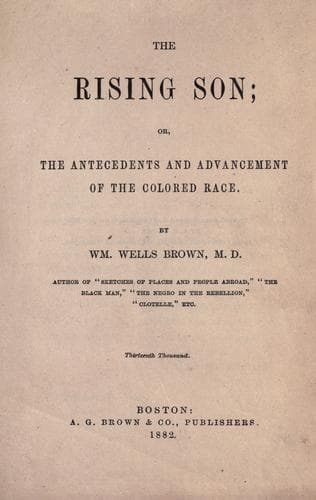
The Rising Son; or, the Antecedents and Advancement of the Colored RaceBrown, William Wells
History
The Rising Son; or, the Antecedents and Advancement of the Colored Race
Brown, William Wells
African Americans -- Biography; African Americans -- History; Black race; Slavery -- United States
“I speak in the spirit of the British Law, which makes liberty
commensurate with, and inseparable from, the British soil; which
proclaims, even to the stranger and the sojourner, the moment he sets
his foot upon British earth, that the ground on which he treads is
holy, and consecrated by the genius of Universal Emancipation. No
matter in what language his doom may have been pronounced; no matter
what complexion, incompatible with freedom, an Indian or an African
sun may have burnt upon him; no matter in what disastrous battle his
liberty may have been cloven down; no matter with what solemnities he
may have been devoted upon the altar of slavery; the first moment he
touches the sacred soil of Britain, the altar and the god sink together
in the dust; his soul walks abroad in her own majesty; his body swells
beyond the measure of his chains, that burst from around him, and he
stands redeemed, regenerated, and disenthralled, by the irresistible
genius of universal emancipation.”
The name and labors of Granville Sharp have been overshadowed by those
of other men, who reaped in the full, bright sunshine of success the
harvest of popular admiration for the results of a philanthropic
policy, of which Granville Sharp was the seed-sower. Zachary, Macaulay,
Clarkson, Wilberforce, and Buxton are regarded as the leaders of the
great movement that emancipated the slaves of Great Britain. Burke and
Wilkes are remembered as the enlightened advocates of the Independence
of America; and these great names throw a shadow over the Clerk in the
Ordnance, who, with high-souled integrity, resigned his place, and
gave up a calling that was his only profession and livelihood, rather
than serve a government that waged a fratricidal war, and who, in
defiance of the opinions of the Solicitor and Attorney-General, and of
the Lord Chief-Justice, opposed by all the lawyers, and forsaken even
by his own professional advisers, undertook to search the indices of
a law library, to wade through an immense mass of dry and repulsive
literature, and to make extracts from all the most important Acts of
Parliament as he went along; until, at the very time that slaves were
being sold by auction in Liverpool and London, and when he could not
find a single lawyer who agreed with his opinion, he boldly exclaimed,
“God be thanked! there is nothing in any English law or statute that
can justify the enslaving of others.”
Public-domain text, read in full here on John Shaqi.
Reviews
Reviews
No reviews yet
Be the first to share your thoughts on this work.
Elsewhere in the archive
Join the Discussion
Join the discussion
Sign in to leave a comment or review.
Sign InorCreate an account