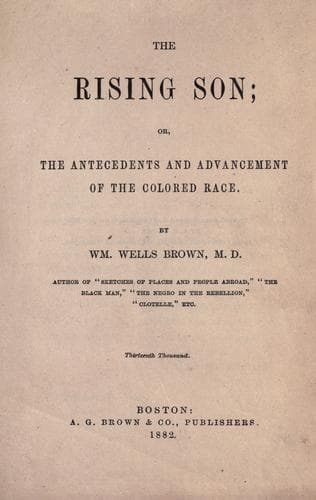
The Rising Son; or, the Antecedents and Advancement of the Colored RaceBrown, William Wells
History
The Rising Son; or, the Antecedents and Advancement of the Colored Race
Brown, William Wells
African Americans -- Biography; African Americans -- History; Black race; Slavery -- United States
Granville Sharp, in his boyhood a linen-draper’s apprentice, and
afterwards a clerk in the Ordnance Department of England, one day,
in the surgery of his brother, saw a negro named Jonathan Strong,
lame, unable to work, almost blind, very ill, and turned adrift in the
streets of London, by his master, a lawyer in Barbadoes. The assistance
of Granville Sharp, and of his brother William, the surgeon, restored
Jonathan Strong to health, and obtained for him a situation. Two years
afterwards, the Barbadoes lawyer recognized his slave, strong, healthy,
and valuable, serving as a footman behind a lady’s carriage, and he
arrested the negro, and put him in prison, until there should be an
opportunity to ship him for the West Indies.
Mr. Sharp appealed to the Lord Mayor, who, although he decided that he
was incompetent to deal with the legal question of the black’s freedom,
released Strong, because there was no offence charged against him.
And then--it was in 1767--now more than a hundred years ago--then began
the protracted movement in England in favor of the slave. The master
of Jonathan Strong immediately commenced an action against Granville
Sharp, to recover possession of his negro, of whom he said he had been
robbed: and Sharp drew up the result of his study of the question, in a
plain, clear, and manly statement, which, after having been circulated
some time in manuscript, was printed in 1769, and was headed, “On the
injustice of tolerating slavery in England.”
It produced such an effect on the opinion of the public, that the
lawyer abandoned his proceedings. Other cases soon tested the earnest
philanthropy of the slaves’ friend. The wife of one Styles was seized
and sent to Barbadoes. Sharp compelled the aggressor to bring the
woman back. In 1776, Thomas Lewis was kidnapped and shipped for
Jamaica. Sharp found him chained to the mainmast of a ship at Spithead,
and by a writ of _habeas corpus_ brought him before Lord Mansfield, the
very judge whose opinion had been most strongly expressed in opposition
to that entertained by Granville Sharp on the subject of slavery.
Lord Mansfield discharged the negro, because no evidence was adduced
to show that he was ever nominally the property of the man who claimed
him; but the great question of liberty or slavery remained as undecided
as before. At this time the slave-trade was carried on openly in the
streets of London, Bristol, and Liverpool.
Negro slavery was enforced by merchants, supported by lawyers, and
upheld by judges; and that a clerk in a public office, without personal
influence, and armed, only with integrity and moral courage, should,
under such circumstances, assert, and, in the end, should prove, that
the slave who sets his foot on British ground becomes at that instant
free, is one of the most striking incidents in modern history.
Public-domain text, read in full here on John Shaqi.
Reviews
Reviews
No reviews yet
Be the first to share your thoughts on this work.
Elsewhere in the archive
Join the Discussion
Join the discussion
Sign in to leave a comment or review.
Sign InorCreate an account