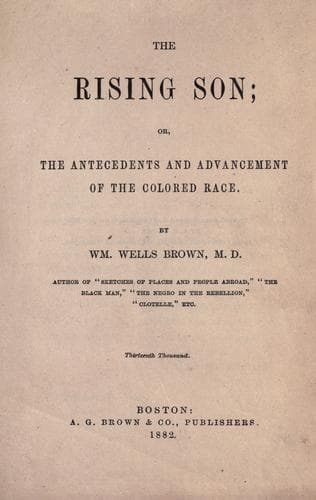
The Rising Son; or, the Antecedents and Advancement of the Colored RaceBrown, William Wells
History
The Rising Son; or, the Antecedents and Advancement of the Colored Race
Brown, William Wells
African Americans -- Biography; African Americans -- History; Black race; Slavery -- United States
An opportunity for bringing the conflicting opinions to an issue soon
occurred. A negro named James Somerset had been taken to England and
left there by his master, who afterwards wished to send him back to
Jamaica. Sharp found counsel to defend the negro, and Lord Mansfield
intimated that the case was one of such general concern, that he should
take the opinions of all the judges upon it. The case was adjourned
and readjourned, and was carried over from term to term; but at length
Lord Mansfield declared the court to be clearly of opinion that “the
claim of slavery never can be supported in England; that the power
claimed never was in use in England nor acknowledged by law; and
that, therefore, the man James Somerset, must be discharged.” By this
judgment, the slave-trade in England was effectually abolished.
History affords no nobler picture than that of Granville Sharp.
Standing alone, opposed to the opinions of the ablest lawyers, and the
most rooted prejudices and customs of the times; fighting unassisted
the most memorable battle for the constitution of his country, and for
the liberties of British subjects, and by his single exertions gaining
a most memorable victory.
On the 1st of August, 1838, eight hundred thousand African bondmen were
made fully and unconditionally free; an act of legislation the most
magnanimous and sublime in the annals of British history. Although the
enemies of emancipation had predicted that murder and pillage would
follow such an act, the conduct of the freed people was everything that
the most ardent friends of the Negro could wish.
On the evening of the day preceding that which witnessed the actual
bestowment of the inestimable boon on the apprentices of Jamaica,
the towns and missionary stations throughout the Island were crowded
with people especially interested in the event, and who, filling the
different places of worship, remained in some instances performing
different acts of devotion until the day of liberty dawned, when they
saluted it with the most joyous acclamations. Others, before and
after similar services, dispersed themselves in different directions
throughout the town and villages, singing the national anthem and
devotional hymns, occasionally rending the air with their acclamations
of “Freedom’s come! We’re free, we’re free; our wives and our children
are free!”
The conduct of the newly-emancipated peasantry everywhere, would have
done credit to Christians of the most civilized country in the world.
Their behavior was modest, unassuming, civil, and obliging to each
other as members of one harmonious family.
Public-domain text, read in full here on John Shaqi.
Reviews
Reviews
No reviews yet
Be the first to share your thoughts on this work.
Elsewhere in the archive
Join the Discussion
Join the discussion
Sign in to leave a comment or review.
Sign InorCreate an account