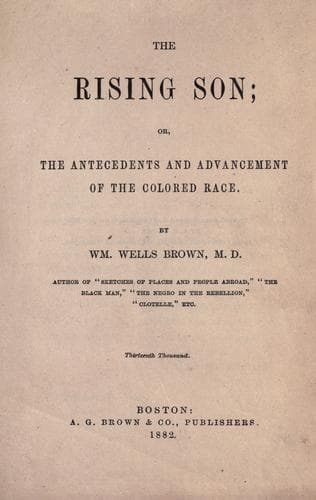
The Rising Son; or, the Antecedents and Advancement of the Colored RaceBrown, William Wells
History
The Rising Son; or, the Antecedents and Advancement of the Colored Race
Brown, William Wells
African Americans -- Biography; African Americans -- History; Black race; Slavery -- United States
Many of the original stock of slaves had been imported from amongst the
Mandingoes, and Foulahs, from the banks of the Senegal, the Gambia,
and the Rio Grande, the most refined and intellectual of the African
tribes; and from the Congoes of Upper and Lower Guinea, the most
inferior of the African race. The latter class brought with them all
the vices and superstitions of their native land, and these had been
cultivated in Jamaica.
The worst of these superstitious ideas was obeism, a species of
witchcraft employed to revenge injuries, or as a protection against
theft and murder, and in favor for gaining the love of the opposite
sex. It consisted in placing a spell or charm near the cottage of
the individual intended to be brought under its influence, or when
designed to prevent the depredations of thieves, in some conspicuous
part of the house, or on a tree; it was signified by a calabash or
gourd, containing among other ingredients, a combination of different
colored rags, cats’ teeth, parrots’ feathers, toads’ feet, egg-shells,
fish-bones, snakes’ teeth, and lizards’ tails.[45]
Terror immediately seized upon the individual who beheld it, and
either by resigning himself to despair, or by the secret communication
of poison, in most cases death was the inevitable consequence. Similar
to the influence of this superstition was that of their solemn curses
pronounced upon thieves, but which would be too tedious to detail here.
All of the Negro physicians of the olden times professed to have the
gift of obeism, and were feared far more than they were loved.
Dreams and visions constituted fundamental articles of their religious
creed. Some supernatural revelations were regarded as indispensable
to qualify for admission to the full privileges of their community.
Candidates were required, indeed, to dream a certain number of dreams
before they were received to membership, the subjects of which were
given them by their teachers.
The meetings of this fraternity were frequently prolonged through
nearly half the night. The ministers enjoined on their followers the
duty of fasting one or two days in the week, and encouraged a weekly
meeting at each other’s houses, alternately, to drink “hot water”
out of white tea-cups (the whole of the tea-table paraphernalia
corresponding), which they designated by the absurd and inappropriate
epithet of “breaking the peace.” To such a deplorable extent did
they carry these superstitious practices, and such was the degree of
ignorance on the part of both minister and people, that, in the absence
of better information as to what was to be sung in their religious
assemblies, they were in the habit of singing the childish story of
“The house that Jack built.”
Public-domain text, read in full here on John Shaqi.
Reviews
Reviews
No reviews yet
Be the first to share your thoughts on this work.
Elsewhere in the archive
Join the Discussion
Join the discussion
Sign in to leave a comment or review.
Sign InorCreate an account