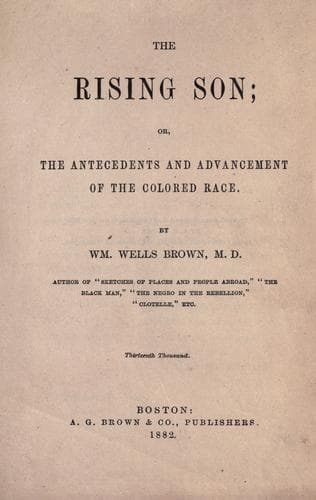
The Rising Son; or, the Antecedents and Advancement of the Colored RaceBrown, William Wells
History
The Rising Son; or, the Antecedents and Advancement of the Colored Race
Brown, William Wells
African Americans -- Biography; African Americans -- History; Black race; Slavery -- United States
The ladies connected with this society, headed by Maria Weston Chapman,
held an annual fair, and raised funds for the prosecution of the work
of changing public sentiment, and otherwise aiding the anti-slavery
movement. Lecturing agents were kept in the field the year round, or
as far as their means would permit. A few clergymen had already taken
ground against the blood-stained sin, and were singled out by both
pulpit and press, as marks for their poisoned arrows. The ablest and
most ultra of these, was Theodore Parker, the singularly gifted and
truly eloquent preacher of the 28th Congregational Society of Boston.
Thomas Wentworth Higginson, though younger and later in the cause,
was equally true, and was amongst the first to invite anti-slavery
lecturers to his pulpit. The writer of this, a negro, at his invitation
occupied his desk at Newburyport, when it cost something to be an
abolitionist.
Brave men of other denominations, in different sections of the country,
were fast taking their stand with the friends of the slave.
The battle in Congress was raging hotter and hotter. The Florida war,
the admission of Texas, and the war against Mexico, had given the
slaveholders a bold front, and they wielded the political lash without
the least mercy or discretion upon all who offended them. Greater
protection for slave property in the free states was demanded by those
who saw their human chattels escaping.
The law of 1793, for the recapture of fugitive slaves, was now
insufficient for the great change in public opinion, and another
code was asked for by the South. On the 18th of September, 1850, the
Fugitive Slave Bill was passed, and became the law of the land.
This was justly condemned by good men of all countries, as the most
atrocious enactment ever passed by any legislative body. The four
hundred thousand free colored residents in the non slave-holding
states, were liable at any time to be seized under this law and
carried into servitude.
Intense excitement was created in every section of the free states
where any considerable number of colored persons resided. In
Pennsylvania, New York, and Ohio, where there were many fugitives
and descendants of former slaves, the feeling rose to fever-heat.
Every railroad leading toward Canada was thronged with blacks fleeing
for safety. In one town in the State of New York, every member of a
Methodist Church, eighty-two in number, including the pastor, fled to
Canada.
The passage of the Fugitive Slave Bill was a sad event to the colored
citizens of this State. At that time there were eight thousand nine
hundred and seventy-five persons of color in Massachusetts. In
thirty-six hours after the passage of the bill was known here, five and
thirty colored persons applied to a well-known philanthropist in this
city for counsel. Before sixty hours passed by, more than forty had
fled. The laws of Massachusetts could not be trusted to shelter her own
children; they must flee to Canada.[52]
Public-domain text, read in full here on John Shaqi.
Reviews
Reviews
No reviews yet
Be the first to share your thoughts on this work.
Elsewhere in the archive
Join the Discussion
Join the discussion
Sign in to leave a comment or review.
Sign InorCreate an account