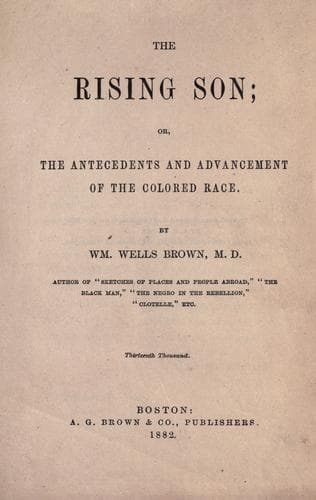
The Rising Son; or, the Antecedents and Advancement of the Colored RaceBrown, William Wells
History
The Rising Son; or, the Antecedents and Advancement of the Colored Race
Brown, William Wells
African Americans -- Biography; African Americans -- History; Black race; Slavery -- United States
Numbers of these fugitives had escaped many years before, had married
free partners, had acquired property, and had comfortable homes; these
were broken up and their members scattered. Soon after the law went
into force, the kidnappers made their appearance in Boston.
The fact that men-stealers were prowling about the streets, through
which, eighty years before, the enemies of liberty had been chased,
caused no little sensation amongst all classes, and when it was
understood that William Craft and his beautiful quadroon wife were
the intended victims, the excitement increased fearfully. These two
persons had escaped from Macon, in the State of Georgia, a year and a
half before. The man was of unmixed negro, the woman, nearly white.
Their mode of escape was novel. The wife, attired as a gentleman,
attended by her husband as a slave, took the train for the North, and
arrived in Philadelphia, after a journey of two days; part of which
was made on steamboats. The writer was in the Quaker City at the time
of their arrival, and was among the first to greet them. Many exciting
incidents occurred during the passage to the land of freedom, which
gave considerable notoriety to the particular case of the Crafts, and
the slave-catchers were soon marked men.
After many fruitless attempts to have the fugitives arrested, Hughs and
his companions returned to the South; while Craft and his wife fled to
England.
Boston was not alone in her commotion; Daniel had been arrested at
Buffalo, and taken before Henry K. Smith, a drunken commissioner, and
remanded to his claimant; Hamlet was captured by the kidnappers in
New York City, and Jerry was making his name famous by his arrest at
Syracuse, in the same state.
The telegrams announcing these events filled the hearts of the blacks
with sad emotions, and told the slave-holders that the law could be
executed. News soon came from Ohio, Illinois, Indiana, and other
states, of the arrest and rendition of persons claimed as slaves, many
of whom were proven to be free-born. Boston was not permitted to remain
long ere she again witnessed the reappearance of the negro-catcher.
A colored man named Shadrach was claimed as a slave; he was arrested,
put in prison, and the kidnappers felt that for once they had a sure
thing. Boston, however, was a strange place for a human being to be
in a dungeon for wanting to be free; and Shadrach was spirited away
to Canada, no one knew how. The men of Boston who traded largely with
the South, felt that their city was in disgrace in not being able to
execute the Fugitive Slave Bill, and many of them wished heartily for
another opportunity.
So, on the night of the third of April, 1851, Thomas Simms was
arrested, and after a trial which became historical, was sent back into
slavery, to the utter disgrace of all concerned in his return.
Public-domain text, read in full here on John Shaqi.
Reviews
Reviews
No reviews yet
Be the first to share your thoughts on this work.
Elsewhere in the archive
Join the Discussion
Join the discussion
Sign in to leave a comment or review.
Sign InorCreate an account