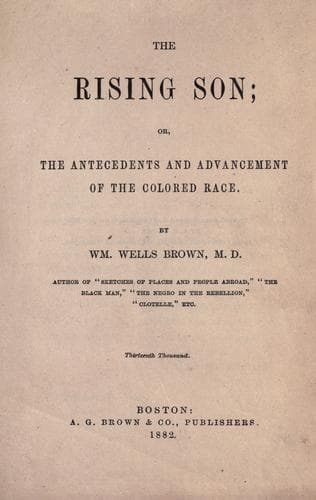
The Rising Son; or, the Antecedents and Advancement of the Colored RaceBrown, William Wells
History
The Rising Son; or, the Antecedents and Advancement of the Colored Race
Brown, William Wells
African Americans -- Biography; African Americans -- History; Black race; Slavery -- United States
Next came the rendition of Anthony Burns, a Baptist clergyman, who
was arrested at the instance of Charles F. Suttle, of Virginia. The
commissioner before whom the case was tried was Ellis Greely Loring.
This trial excited even more commotion than did the return of Simms. A
preacher in fetters because he wanted to be free was a new thing to the
people of Boston.
During the progress of the hearing, the feeling extended to the country
towns, and nearly every train coming in brought large numbers of
persons anxious to behold the new order of things. To guard against the
possibility of a rescue, the building in which the commissioner did his
work was in chains. Burns was delivered to Suttle, and the Union was
once more safe.
The Boston Court House in chains, two hundred rowdies and thieves sworn
in as special policemen, respectable citizens shoved off the sidewalks
by these slave-catchers, all for the purpose of satisfying “our
brethren of the South.”
But this act did not appease the feelings or satisfy the demands of the
slave-holders, while it still further inflamed the fire of abolitionism.
The “Dred Scott Decision” added fresh combustibles to the smouldering
heap. Dred Scott, a slave, taken by his master into free Illinois, and
then beyond the line of thirty-six degrees thirty minutes, and then
back into Missouri, sued for and obtained his freedom, on the ground
that having been taken where, by the Constitution, slavery was illegal,
his master lost all claim.
But the Supreme Court, on appeal, reversed the judgment, and Dred
Scott, with his wife and children, was taken back into slavery.
FOOTNOTE:
[52] “Rendition of Thomas Simms.” Theodore Parker, p. 20, 1852.
CHAPTER XLI.
RELIGIOUS STRUGGLES.
Caste, the natural product of slavery, did not stop at the door of the
sanctuary, as might be presumed that it would, but entered all, or
nearly all, of the Christian denominations of our country, and in some
instances even pursued the negro to the sacramental altar. All churches
had their “Negro-pew,” where there were any blacks to put into them.
This was the custom at the South, and it was the same at the North.
As the religion of the country was fashioned to suit the public
sentiment, which was negro-hating in its character, the blacks of the
United States would have formed a poor idea of the Christian religion
in its broadest sense, had not an inward monitor told them that there
was still something better.
Public-domain text, read in full here on John Shaqi.
Reviews
Reviews
No reviews yet
Be the first to share your thoughts on this work.
Elsewhere in the archive
Join the Discussion
Join the discussion
Sign in to leave a comment or review.
Sign InorCreate an account