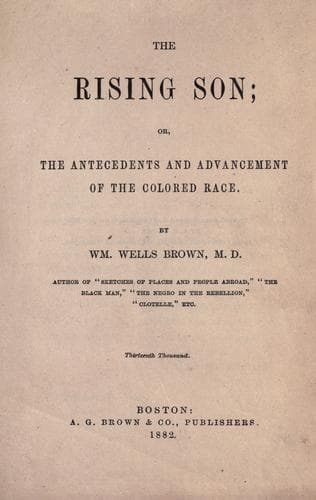
The Rising Son; or, the Antecedents and Advancement of the Colored RaceBrown, William Wells
History
The Rising Son; or, the Antecedents and Advancement of the Colored Race
Brown, William Wells
African Americans -- Biography; African Americans -- History; Black race; Slavery -- United States
The first step towards the enjoyment of religious freedom was taken
by the colored people of Philadelphia. This was caused by the unkind
treatment of their white brethren, who considered them a nuisance in
their houses of worship, where they were pulled off their knees while
in the act of prayer, and ordered to the back seats. From these and
other acts of unchristian conduct, the blacks considered it their duty
to devise means of having a house for religious worship, of their own.
Therefore, in November, 1787, they seceded from the Methodist Church,
in Philadelphia, formed a society, built a house to meet in, and set up
for themselves.
Although the whites considered the blacks as intruders in their
churches, they were, nevertheless, unwilling to allow them to worship
by themselves, unless they should have the privilege of furnishing
their sable brethren with preachers. The whites denied the blacks
the right of taking the name of Methodist without their consent, and
even went so far as to force their white preachers into the pulpits
of the colored people on Sundays. The law, however, had more justice
in it than the Gospel; and it stepped in between the blacks and their
religious persecutors, and set the former free.
In 1793, Rev. Richard Allen built a church for his people in
Philadelphia, and henceforth their religious progress was marvellous.
In 1816, Richard Allen was ordained Bishop of the African Methodist
Episcopal Church; Morris Brown was ordained a bishop in 1828; Edward
Waters in 1836; and William P. Quinn in 1844. These were known as the
Bethel Methodists. About the same time, the colored Christians of New
York, feeling the pressure of caste, which weighed heavily upon them,
began to sigh for the freedom enjoyed by their brethren in the City of
Brotherly Love; and in 1796, under the lead of Francis Jacobs, William
Brown, and William Miller, separated from their white brethren, and
formed a church, now known as the African Methodist Episcopal Zion
Church. This branch of seceders equalled in prosperity their brethren
in Philadelphia.
The first annual conference of these churches was held in the city of
Baltimore, in April, 1818. The example set by the colored ministers of
Philadelphia and New York was soon followed by their race in Baltimore,
Richmond, Boston, Providence, and other places. These independent
religious movements were not confined to the sect known as Methodists,
but the Baptists, Presbyterians, and Episcopalians were permitted to
set up housekeeping for themselves.
Public-domain text, read in full here on John Shaqi.
Reviews
Reviews
No reviews yet
Be the first to share your thoughts on this work.
Elsewhere in the archive
Join the Discussion
Join the discussion
Sign in to leave a comment or review.
Sign InorCreate an account