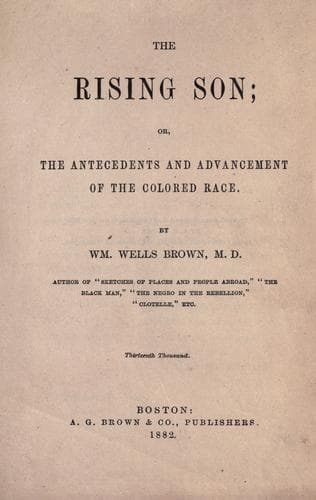
The Rising Son; or, the Antecedents and Advancement of the Colored RaceBrown, William Wells
History
The Rising Son; or, the Antecedents and Advancement of the Colored Race
Brown, William Wells
African Americans -- Biography; African Americans -- History; Black race; Slavery -- United States
The Episcopalians, however, in New York and Philadelphia, had to suffer
much, for they were compelled to listen to the preacher on Sunday who
would not recognize them on Monday. The settlement of the Revs. Peter
Williams at New York, and William Douglass at Philadelphia, seemed
to open a new era to the blacks in those cities, and the eloquence
of these two divines gave the members of that sect more liberty
throughout the country. In the Southern States, the religious liberty
of the blacks was curtailed far more than at the North. The stringent
slave-law, which punished the negro for being found outside of his
master’s premises after a certain time at night, was construed so as to
apply to him in his going to and from the house of God; and the poor
victim was often flogged for having been found out late, while he was
on his way home from church.
These laws applied as well to the free blacks as to the slaves, and
frequently the educated colored preacher had his back lacerated with
the “cat-o’-nine-tails” within an hour of his leaving the pulpit.
In all of the slave states laws were early enacted regulating the
religious movements of the blacks, and providing that no slave or free
colored person should be allowed to preach. The assembling of blacks
for religious worship was prohibited, unless three or more white
persons were present.
CHAPTER XLII.
JOHN BROWN’S RAID ON HARPER’S FERRY.
The year 1859 will long be memorable for the bold attempt of John Brown
and his companions to burst the bolted door of the Southern house of
bondage, and lead out the captives by a more effectual way than they
had yet known; an attempt in which, it is true, the little band of
heroes dashed themselves to bloody death, but, at the same time, shook
the prison walls from summit to foundation, and shot wild alarm into
every tyrant heart in all the slave-land. What were the plans and
purposes of the noble old man is not precisely known, and perhaps will
never be; but whatever they were, there is reason to believe they had
been long maturing,--brooded over silently and secretly, with much
earnest thought, and under a solemn sense of religious duty.
Of the five colored men who were with the hero at the attack on
Harper’s Ferry, only two, Shields Green and John A. Copeland, were
captured alive. The first of these was a native of South Carolina,
having been born in the city of Charleston, in the year 1832. Escaping
to the North in 1857, he resided in Rochester, New York, until
attracted by the unadorned eloquence and native magnetism of John Brown.
Shields Green was of unmixed blood, good countenance, bright eye, and
small in figure. One of his companions in the Harper’s Ferry fight,
says of Green, “He was the most inexorable of all our party; a very
Turco in his hatred against the stealers of men. Wiser and better
men no doubt there were, but a braver man never lived than Shields
Green.”[53]
Public-domain text, read in full here on John Shaqi.
Reviews
Reviews
No reviews yet
Be the first to share your thoughts on this work.
Elsewhere in the archive
Join the Discussion
Join the discussion
Sign in to leave a comment or review.
Sign InorCreate an account