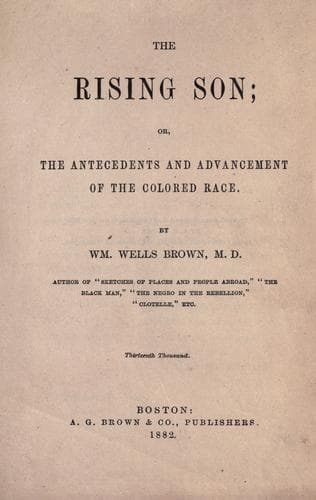
The Rising Son; or, the Antecedents and Advancement of the Colored RaceBrown, William Wells
History
The Rising Son; or, the Antecedents and Advancement of the Colored Race
Brown, William Wells
African Americans -- Biography; African Americans -- History; Black race; Slavery -- United States
He behaved with becoming coolness and heroism at his execution,
ascending the scaffold with a firm, unwavering step, and died as he had
lived, a brave man, expressing to the last his eternal hatred to human
bondage, prophesying that slavery would soon come to a bloody end.
John A. Copeland was from North Carolina, and was a mulatto of superior
abilities, and a genuine lover of liberty and justice. He died as
became one who had linked his fate with that of the hero of Harper’s
Ferry.
FOOTNOTE:
[53] “A Voice from Harper’s Ferry.” O. P. Anderson.
CHAPTER XLIII.
LOYALTY AND BRAVERY OF THE BLACKS.
The assault on Fort Sumter on the 12th of April, 1861, was the dawn of
a new era for the Negro. The proclamation of President Lincoln, calling
for the first seventy-five thousand men to put down the Rebellion, was
responded to by the colored people throughout the country. In Boston,
at a public meeting of the blacks a large number came forward, put
their names to an agreement to form a brigade, and march at once to
the seat of war. A committee waited on the Governor three days later,
and offered the services of these men. His Excellency replied that he
had no power to receive them. This was the first wet blanket thrown
over the negro’s enthusiasm. “This is a white man’s war,” said most of
the public journals. “I will never fight by the side of a nigger,” was
heard in every quarter where men were seen in Uncle Sam’s uniform.
Wherever recruiting offices were opened, black men offered themselves,
and were rejected. Yet these people, feeling conscious that right would
eventually prevail, waited patiently for the coming time, pledging
themselves to go at their country’s call.
While the country seemed drifting to destruction, and the
administration without a policy, the heart of every loyal man was
made glad by the appearance of the proclamation of Major-General John
C. Fremont, then in command at the West. The following extract from
that document, which at the time caused so much discussion, will bear
insertion here:--
“All persons who shall be taken with arms in their hands within these
lines, shall be tried by court-martial; and if found guilty, will be
shot. The property, real and personal, of all persons in the State of
Missouri, who shall take up arms against the United States, or who
shall be directly proven to have taken active part with their enemies
in the field, is declared to be confiscated to the public use, and
their slaves, if any they have, are hereby declared free men.”
The above was the first official paper issued after the commencement of
the war, that appeared to have the ring of the right kind of mettle.
Public-domain text, read in full here on John Shaqi.
Reviews
Reviews
No reviews yet
Be the first to share your thoughts on this work.
Elsewhere in the archive
Join the Discussion
Join the discussion
Sign in to leave a comment or review.
Sign InorCreate an account