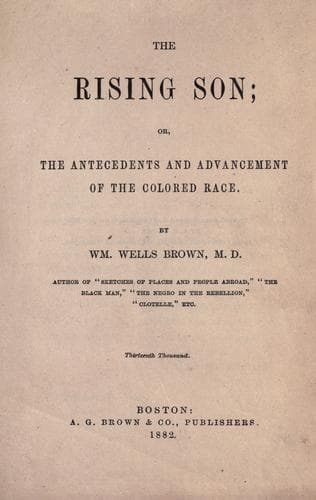
The Rising Son; or, the Antecedents and Advancement of the Colored RaceBrown, William Wells
History
The Rising Son; or, the Antecedents and Advancement of the Colored Race
Brown, William Wells
African Americans -- Biography; African Americans -- History; Black race; Slavery -- United States
Without waiting for instructions from the capital, General Fremont
caused manumission papers to be issued to a number of slaves,
commencing with those owned by Thomas L. Snead, of St. Louis. This
step taken by the brave Fremont was followed by a similar movement of
General Hunter, then stationed in South Carolina. President Lincoln,
however, was persuaded to annul both of the above orders.
In the month of June, 1861, the schooner S. J. Waring, from New York,
bound to South America, was captured on the passage by the rebel
privateer Jeff Davis, a prize-crew put on board, consisting of a
captain, mate, and four seamen, and the vessel set sail for the port of
Charleston, South Carolina. Three of the original crew were retained
on board, a German as steersman, a Yankee, who was put in irons, and a
black man named William Tillman, the steward and cook of the schooner.
The latter was put to work at his usual business, and told that he was
henceforth the property of the Confederate States, and would be sold on
his arrival at Charleston as a slave.
Night comes on; darkness covers the sea; the vessel is gliding swiftly
towards the South; the rebels, one after another, retire to their
berths; the hour of midnight approaches; all is silent in the cabin;
the captain is asleep; the mate, who has charge of the watch, takes
his brandy toddy, and reclines upon the quarter-deck. The negro thinks
of home and all its endearments; he sees in the dim future chains and
slavery.
He resolves, and determines to put the resolution into practice upon
the instant. Armed with a heavy club, he proceeds to the captain’s
room. He strikes the fatal blow. He next goes to the adjoining room;
another blow is struck, and the black man is master of the cabin.
Cautiously he ascends to the deck, strikes the mate. The officer is
wounded, but not killed. He draws his revolver, and calls for help.
The crew are aroused; they are hastening to aid their commander. The
negro repeats his blows with the heavy club; the rebel falls dead at
Tillman’s feet. The African seizes the revolver, drives the crew below
deck, orders the release of the Yankee, puts the enemy in irons, and
proclaims himself master of the vessel.
Five days more, and the “S. J. Waring” arrives in the port of New York,
under the command of William Tillman, the negro patriot.
The brave exploit of Tillman had scarcely ceased being the topic of
conversation, ere the public were again startled by the announcement
that Robert Small, a slave, had escaped with the steamer Planter
from Charleston, South Carolina. This event was communicated to the
Secretary of War, by Commodore Dupont.
Up to this time, the services of colored men in the war had not been
recognized; however, soon after Major-General B. F. Butler accepted and
acknowledged their services in Louisiana.
Public-domain text, read in full here on John Shaqi.
Reviews
Reviews
No reviews yet
Be the first to share your thoughts on this work.
Elsewhere in the archive
Join the Discussion
Join the discussion
Sign in to leave a comment or review.
Sign InorCreate an account