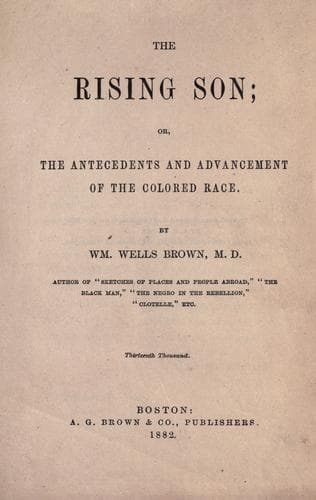
The Rising Son; or, the Antecedents and Advancement of the Colored RaceBrown, William Wells
History
The Rising Son; or, the Antecedents and Advancement of the Colored Race
Brown, William Wells
African Americans -- Biography; African Americans -- History; Black race; Slavery -- United States
When they had come within six hundred yards of Fort Wagner, they formed
in line of battle, the colonel heading the first, and the major the
second battalion. This was within musket-shot of the enemy. There
was little firing from the enemy; a solid shot falling between the
battalions, and another falling to the right, but no musketry. At this
point, the regiment, together with the next supporting regiment, the
Sixth Connecticut, Ninth Maine, and others, remained half an hour. The
regiment was addressed by General Strong and by Colonel Shaw. Then, at
seven and a half or seven and three-quarters o’clock, the order for
the charge was given. The regiment advanced at quick time, changed to
double-quick when at some distance on.
The intervening distance between the place where the line was formed
and the fort was run over in a few minutes. When about one hundred
yards from the fort, the rebel musketry opened with such terrible
effect that for an instant the first battalion hesitated,--but only
for an instant; for Colonel Shaw, springing to the front and waving
his sword, shouted, “Forward, my brave boys!” and with another cheer
and a shout they rushed through the ditch, gained the parapet on the
right, and were soon engaged in a hand-to-hand conflict with the enemy.
Colonel Shaw was one of the first to scale the walls. He stood erect,
to urge forward his men, and while shouting for them to press on was
shot dead, and fell into the fort. His body was found, with twenty of
his men lying dead around him; two lying on his own body.
The Fifty-fourth did well and nobly; only the fall of Colonel Shaw
prevented them from entering the fort. They moved up as gallantly as
any troops could, and with their enthusiasm, they deserved a better
fate.
Sergeant-Major Lewis H. Douglass, son of Frederick Douglass, the
celebrated orator, sprang upon the parapet close behind Colonel Shaw,
and cried out, “Come, boys, come; let’s fight for God and Governor
Andrew.” This brave young man was the last to leave the parapet. Before
the regiment reached the parapet, the color-sergeant was wounded; and
while in the act of falling, the colors were seized by Sergeant William
H. Carney, who bore them up, and mounted the parapet, where he, too,
received three severe wounds. But on orders being given to retire, the
color-bearer, though almost disabled, still held the emblem of liberty
in the air, and followed his regiment by the aid of his comrades,
and succeeded in reaching the hospital, where he fell exhausted and
almost lifeless on the floor, saying, “The old flag never touched the
ground, boys.” Captain Lewis F. Emilio, the junior captain,--all of his
superiors having been killed or wounded,--took command, and brought the
regiment into camp. In this battle, the total loss in officers and men,
killed and wounded, was two hundred and sixty-one.
Public-domain text, read in full here on John Shaqi.
Reviews
Reviews
No reviews yet
Be the first to share your thoughts on this work.
Elsewhere in the archive
Join the Discussion
Join the discussion
Sign in to leave a comment or review.
Sign InorCreate an account