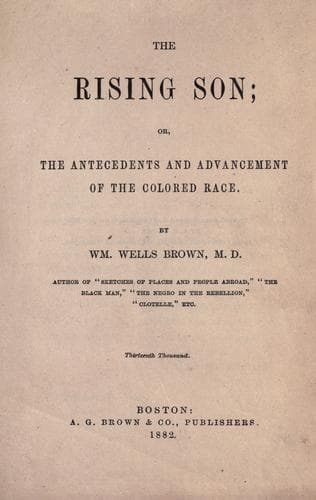
The Rising Son; or, the Antecedents and Advancement of the Colored RaceBrown, William Wells
History
The Rising Son; or, the Antecedents and Advancement of the Colored Race
Brown, William Wells
African Americans -- Biography; African Americans -- History; Black race; Slavery -- United States
When inquiry was made at Fort Wagner, under flag of truce, for the body
of Colonel Shaw of the Massachusetts Fifty-fourth, the answer was,
“We have buried him with his niggers!” It is the custom of savages to
outrage the dead, and it was only natural that the natives of South
Carolina should attempt to heap insult upon the remains of the brave
young soldier; but that wide grave on Morris Island will be to a whole
race a holy sepulchre. No more fitting place for burial, no grander
obsequies could have been given to him who cried, as he led that
splendid charge, “On, my brave boys,” than to give to him and to them
one common grave.
Shaw’s Regiment afterwards distinguished itself in the hard-fought
battle of Olustee, an engagement that will live in the history of the
Rebellion.
The battle of Olustee was fought in a swamp situated thirty-five
miles west of Jacksonville, and four miles from Sanderson, in the
State of Florida. The expedition was under the immediate command
of General C. Seymour, and consisted of the Seventh New Hampshire,
Seventh Connecticut, Eighth United States (colored) Battery, Third
United States Artillery, Fifty-fourth Massachusetts (colored), and
First North Carolina (colored). The command having rested on the night
of the 19th of February, 1864, at Barbour’s Ford, on the St. Mary’s
River, took up its line of march on the morning of the 20th, and
proceeded to Sanderson, nine miles to the west, which was reached at
one o’clock, P. M., without interruption; but about three miles beyond,
the advance drove in the enemy’s pickets. The Seventh Connecticut,
being deployed as skirmishers, fell in with the enemy’s force in the
swamp, strengthened still more by rifle-pits. Here they were met by
cannon and musketry; but our troops, with their Spencer rifles, played
great havoc with the enemy, making an attempt to take one of his pieces
of artillery, but failed. However, they held their ground nobly for
three-quarters of an hour, and were just about retiring as the main
body of our troops came up.
The Eighth (colored), which had never been in battle, and which had
been recruited but a few weeks, came up and filed to the right, when
they met with a most terrific shower of musketry and shell. General
Seymour now came up, and pointing in front, towards the railroad, said
to Colonel Fribley, commander of the Eighth, “Take your regiment in
there,”--a place which was sufficiently hot to make the oldest and most
field-worn veterans tremble; and yet these men, who had never heard the
sound of a cannon before, rushed in where they commenced dropping like
grass before the sickle. Still on they went without faltering, until
they came within two hundred yards of the enemy’s strongest works. Here
these brave men stood for nearly three hours before a terrible fire,
closing up as their ranks were thinned out, fire in front, on their
flank, and in the rear, without flinching or breaking.
Public-domain text, read in full here on John Shaqi.
Reviews
Reviews
No reviews yet
Be the first to share your thoughts on this work.
Elsewhere in the archive
Join the Discussion
Join the discussion
Sign in to leave a comment or review.
Sign InorCreate an account