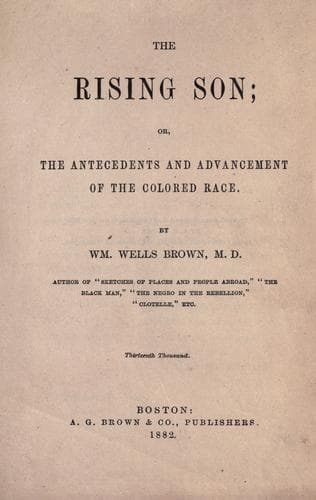
The Rising Son; or, the Antecedents and Advancement of the Colored RaceBrown, William Wells
History
The Rising Son; or, the Antecedents and Advancement of the Colored Race
Brown, William Wells
African Americans -- Biography; African Americans -- History; Black race; Slavery -- United States
Colonel Fribley, seeing that it was impossible to hold the position,
passed along the lines to tell the officers to fire, and fall back
gradually, and was shot before he reached the end. He was shot in the
chest, told the men to carry him to the rear, and expired in a very
few minutes. Major Burritt took command, but was also wounded in a
short time. At this time Captain Hamilton’s battery became endangered,
and he cried out to our men for God’s sake to save his battery. Our
United States flag, after three sergeants had forfeited their lives by
bearing it during the fight, was planted on the battery by Lieutenant
Elijah Lewis, and the men rallied around it; but the guns had been
jammed up so indiscriminately, and so close to the enemy’s lines, that
the gunners were shot down as fast as they made their appearance; and
the horses, whilst they were wheeling the pieces into position, shared
the same fate. They were compelled to leave the battery, and failed to
bring the flag away. The battery fell into the enemy’s hands. During
the excitement, Captain Bailey took command, and brought out the
regiment in good order. Sergeant Taylor, Company D., who carried the
battle-flag, had his right hand nearly shot off, but grasped the colors
with the left hand, and brought them out.
The Seventh New Hampshire was posted on both sides of the wagon-road,
and broke, but soon rallied, and did good execution. The line was
probably one mile long, and all along the fighting was terrific.
Our artillery, where it could be worked, made dreadful havoc on the
enemy; whilst the enemy did us but very little injury with his;
with the exception of one gun, a sixty-four pound swivel, fixed on
a truck-car on the railroad, which fired grape and canister. On the
whole, their artillery was very harmless; but their musketry fearful.
Up to this time, neither the First North Carolina nor the Fifty-fourth
Massachusetts had taken any part in the fight, as they were in the
rear some distance. However, they heard the roar of battle, and were
hastening to the field, when they were met by an aide, who came riding
up to the colonel of the Fifty-fourth, saying, “For God’s sake,
Colonel, double-quick, or the day is lost!” Of all the regiments, every
one seemed to look to the Fifty-fourth Massachusetts with the most
dependence on the field of battle. This regiment was under the command
of Colonel E. N. Hallowell, who fell wounded by the side of Colonel
Shaw, at Fort Wagner, and who, since his recovery, had been in several
engagements, in all of which he had shown himself an excellent officer,
and had gained the entire confidence of his men, who were willing to
follow him wherever he chose to lead. When the aide met these two
regiments, he found them hastening on.
Public-domain text, read in full here on John Shaqi.
Reviews
Reviews
No reviews yet
Be the first to share your thoughts on this work.
Elsewhere in the archive
Join the Discussion
Join the discussion
Sign in to leave a comment or review.
Sign InorCreate an account