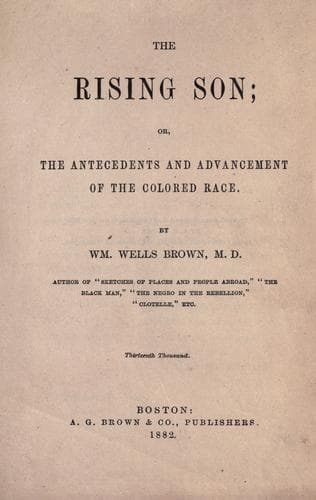
The Rising Son; or, the Antecedents and Advancement of the Colored RaceBrown, William Wells
History
The Rising Son; or, the Antecedents and Advancement of the Colored Race
Brown, William Wells
African Americans -- Biography; African Americans -- History; Black race; Slavery -- United States
The First North Carolina was in light marching order; the Fifty-fourth
Massachusetts was in heavy marching order, with knapsacks, haversacks,
canteens, and every other appurtenance of the soldier. But off went
everything, and they double-quicked on to the field. At the most
critical juncture, just as the rebels were preparing for a simultaneous
charge along the whole line, and they had captured our artillery and
turned it upon us, Colonel James Montgomery, Colonel Hallowell, and
Lieutenant-Colonel Hooper formed our line of battle on right by file
into line.
The Fifty-fourth Massachusetts went in first, with a cheer. They were
followed by the First North Carolina (colored); Lieutenant-Colonel
Reed, in command, headed the regiment, sword in hand, and charged
upon the rebels. They broke when within twenty yards of contact with
our negro troops. Overpowered by numbers, the First North Carolina
fell back in good order, and poured in a destructive fire. Their
colonel fell, mortally wounded. Major Bogle fell wounded, and two
men were killed in trying to reach his body. The Adjutant, William
C. Manning, before wounded at Malvern Hills, got a bullet in his
body, but persisted in remaining until another shot struck him. His
lieutenant-colonel, learning the fact, embraced him, and implored him
to leave the field. The next moment the two friends were stretched
side by side; the colonel had received his own death-wound. But the
two colored regiments had stood in the gap, and saved the army. The
Fifty-fourth Massachusetts, which, with the First North Carolina, may
be truly said to have saved the forces from utter rout, lost eighty men.
There were three color-sergeants shot down; the last one was shot
three times before he relinquished the flag of his country. His name
was Samuel C. Waters, Company C., and his body sleeps where he fell.
The battle-flag carried by Sergeant Taylor was borne through the fight
with the left hand, after the right one was nearly shot off. The rebels
fired into the place where the wounded were being attended to; and
their cavalry was about making a charge on it just as the Fifty-fourth
Massachusetts appeared on the field, when they retired.
Had Colonel Hallowell not seen at a glance the situation of affairs,
the Fifty-fourth Massachusetts Volunteers would have been killed or
captured. When they entered the field with the First North Carolina,
which is a brave regiment, they (the First North Carolina) fired well
while they remained; but they gave way, thus exposing the right. On
the left, the rebel cavalry were posted; and as the enemy’s left
advanced on our right, their cavalry pressed the left. Both flanks
were thus being folded up, and slaughter or capture would have been
the inevitable result. We fell back in good order, and established new
lines of battle, until we reached Sanderson.
Public-domain text, read in full here on John Shaqi.
Reviews
Reviews
No reviews yet
Be the first to share your thoughts on this work.
Elsewhere in the archive
Join the Discussion
Join the discussion
Sign in to leave a comment or review.
Sign InorCreate an account