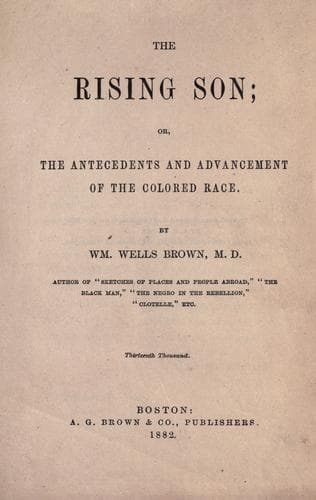
The Rising Son; or, the Antecedents and Advancement of the Colored RaceBrown, William Wells
History
The Rising Son; or, the Antecedents and Advancement of the Colored Race
Brown, William Wells
African Americans -- Biography; African Americans -- History; Black race; Slavery -- United States
Here a scene that beggars description was presented. Wounded men
lined the railroad station; and the roads were filled with artillery,
caissons, ammunition, baggage-wagons, infantry, cavalry, and
ambulances. The only organized bodies ready to repel attack were a
portion of the Fortieth Massachusetts Mounted Infantry, armed with the
Spencer repeating-rifle, the Fifty-fourth Massachusetts Volunteers, and
the Seventh Connecticut, commanded by Colonel Hawley, now governor of
Connecticut.
An occurrence of thrilling interest took place during the battle, which
I must not omit to mention. It was this:--
Colonel Hallowell ordered the color-line to be advanced one hundred
and fifty paces. Three of the colored corporals, Pease, Palmer, and
Glasgow, being wounded, and the accomplished Goodin killed, there were
four only left,--Wilkins, the acting sergeant, Helman, and Lenox. The
colors were perforated with bullets, and the staff was struck near the
grasp of the sergeant; but the color-guard marched steadily out, one
hundred and fifty paces to the front, with heads erect and square to
the front; and the battalion rallied around it, and fought such a fight
as made Colonel Hallowell shout with very joy, and the men themselves
to ring out defiant cheers which made the pines and marshes of Ocean
Pond echo again.
Although these colored men had never been paid off, and their families
at home were in want, they were as obedient, and fought as bravely, as
the white troops, whose pockets contained “greenbacks,” and whose wives
and children were provided for.
The Fifty-fourth Massachusetts went into the battle with “Three cheers
for Massachusetts, and seven dollars a month.”
It is well known that the general in command came to the colonel and
said, “The day is lost; you must do what you can to save the army
from destruction.” And nobly did they obey him. They fired their
guns till their ammunition was exhausted, and then stood with fixed
bayonets till the broken columns had time to retreat, and though once
entirely outflanked, the enemy getting sixty yards in their rear,
their undaunted front and loud cheering caused the enemy to pause, and
allowed them time to change front. They occupied the position as rear
guard all the way back to Jacksonville; and wherever was the post of
danger, there was the Fifty-fourth to be found.
When the forces arrived at Jacksonville, they there learned that the
train containing the wounded was at Ten-Mile Station, where it had
been left, owing to the breaking down of the engine. The Fifty-fourth
Massachusetts, fatigued and worn out as it was, was despatched at once,
late at night, to the assistance of the disabled train. Arriving at
Ten-Mile Station, they found that the only way to bring the wounded
with them was to attach ropes to the cars, and let the men act as
motive power. Thus the whole train of cars containing the wounded from
the battle of Olustee was dragged a distance of ten miles by that brave
colored regiment.
Public-domain text, read in full here on John Shaqi.
Reviews
Reviews
No reviews yet
Be the first to share your thoughts on this work.
Elsewhere in the archive
Join the Discussion
Join the discussion
Sign in to leave a comment or review.
Sign InorCreate an account